






What Ranks Can Play Together in Valorant? 2026 Party Rules
-
- Restored the full list of Valorant ranks in order, with links to our Valorant MMR and Radiant guides
-
- Updated for Season 2026: Acts replace Episodes, new 2026 ranked features, MFA for ranked
- Added Riot’s exact 5-stack RR penalties and fixed the rank tier description
- Removed a link to a boosting service

💡 Highlights
- All ranks can play together in a 5-stack, but mixed ranks cut your RR gains and can mean longer queues.
- Four-stacks are not allowed in Competitive.
- Iron and Bronze can play with players up to Silver. Silver up to Gold. Gold up to Platinum.
- Platinum and above can party with players up to one tier higher.
- Immortal and above can only queue solo, as a duo, or as a full five.
Valorant is a tactical first-person shooter developed by Riot Games, in which not only the skill of the players is important, but also the strategy. One of its key competitive advantages is the ranking system – a structured hierarchy that categorizes players depending on their skill and many other game parameters. This system puts players against players of roughly the same level, making each match a test of strategy, player accuracy, and teamwork. So, what ranks can play together in Valorant? In this article, I will share more details about ranks and answer the most painful question – why some ranks cannot play together?
About Valorant Ranks and the Ranking System
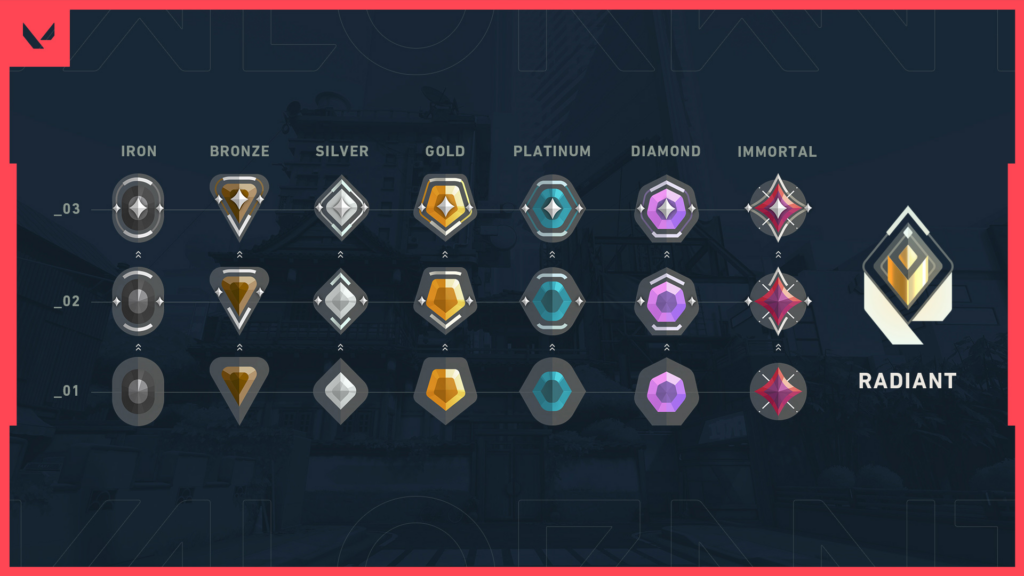
The Valorant rank system has nine ranks. Here are all Valorant ranks in order, from lowest to highest:
- Iron 1, 2, 3
- Bronze 1, 2, 3
- Silver 1, 2, 3
- Gold 1, 2, 3
- Platinum 1, 2, 3
- Diamond 1, 2, 3
- Ascendant 1, 2, 3
- Immortal 1, 2, 3
- Radiant (a single tier)
Every rank except Radiant has three tiers. So you go from Iron 1 to Iron 3, then up to Bronze 1, and so on. Radiant is a single tier. It is only for the top 500 players on each regional leaderboard. Matchmaking also looks at a hidden rating behind your visible rank, which we explain in our Valorant MMR guide.
You need account level 20 to unlock Competitive. At the start of a new Season you play placement matches again. Between Acts in the same Season, one match is enough to get your rank back.
Rank vs Act Rank
Valorant no longer uses Episodes. Since 2025 it runs one Season per year, split into six Acts. Right now we are in Season 2026, Act 6. Your rank is where you stand today. Your Act Rank is your best result in the current Act. It is set by your highest-ranked win. If you are Gold but win one game while Diamond 1, your Act Rank badge shows Diamond 1.
New in 2026: Performance Score and Map Rating
Riot added a few ranked features this year. None of them change who can party with whom, but you will see them in every match.
- Performance Score rates each player from 0 to 500. It now decides MVP and scoreboard order instead of ACS.
- Range in Queue lets you warm up in the Range while you wait for a match.
- Map Rating gives you a score and a C to S grade for each map you play in Competitive and Premier.
- Riot can ask for Riot Mobile verification before you play ranked. It started in NA, Brazil, Korea and LATAM in October 2025, then EU in January 2026 and APAC in February 2026. It applies to Ascendant and higher accounts, and to accounts that look shared.
What Ranks Can Play Together in Valorant?
Party rules depend on how many people are in your group.
| Lowest rank in your party | Highest rank allowed (duo or trio) |
|---|---|
| Iron or Bronze | Silver |
| Silver | Gold |
| Gold | Platinum |
| Platinum, Diamond, Ascendant, Immortal or Radiant | One tier above you (for example, Platinum 2 with up to Diamond 2) |
Five Stack
A full party of five can include any ranks. An Iron player can queue with an Immortal friend. The catch is RR. Riot cuts the RR you gain when the group is mixed:
- If everyone is Ascendant 3 or lower, the team loses 25% of its RR gains when anyone is outside the normal limits.
- If anyone is Immortal 1 to 3, the team loses 25% of its RR gains.
- If anyone is Radiant, the team loses 75% of its RR gains. If that group also has someone below Radiant, the cut rises to 90%.
Queue times can also be longer when the ranks are far apart, and a Valorant live stream from an Immortal player partying with lower-ranked friends shows how long that wait can run.
Four Stack
Four-player parties are not allowed in Competitive. Riot removed them in Patch 3.10. The reason given was that the solo fifth player often felt left out of the group’s comms. You can still four-stack in Unrated and Swiftplay.
Two or Three Stack
Duos and trios follow the table above. One extra rule applies at the top. Players in Immortal 1 or higher can only queue solo, as a duo, or as a full five. They cannot join a trio.

Can Unranked Players Play With Ranked Players?
A player who has not finished placements has no visible rank yet. In our experience they can usually queue with lower-ranked friends, up to around Gold. Riot does not publish an exact rule for this, so treat it as a guide, not a guarantee. If the game blocks your party, finish placements first.
Why You Can’t Play Ranked With Your Friends
The most common reasons are:
- Your ranks are too far apart for a duo or trio. Fix it by finding two more players and going as a five.
- You are in a group of four. Add a fifth or drop to three.
- One of you is Immortal or higher and you are trying to trio.
- One of you has a ranked ban for going AFK, dodging, or chat abuse.
- One of you needs to complete Riot Mobile verification (required for Ascendant and higher accounts, or accounts flagged as shared).
Need Teammates Close to Your Rank? Try GameTree
If your friends are too far apart in rank, you need people near your own level. The GameTree app matches you with Valorant players by rank, region and playstyle. You can also join the GameTree Discord, where our Scout bot puts together groups based on how people like to play. Both are free.
Final Thoughts
Riot Games actively fights not only against cheaters and all kinds of dishonest players but also pays great attention to ensuring that players can get the best gaming experience and compete with equal gamers. Despite some problems, they generally cope well with this task. I hope that in this article, I was able to explain in a little more detail how matchmaking works for different ranks and what ranks can play together in Valorant.
Frequently Asked Questions
What Are The Valorant Ranks In Order?
The Valorant ranks are as follows:
- Iron 1 – 3
- Bronze 1 – 3
- Silver 1 – 3
- Gold 1 – 3
- Platinum 1 – 3
- Diamond 1 – 3
- Ascendant 1 – 3
- Immortal 1 – 3
- Radiant
Can Iron Play With Silver In Valorant?
Yes, Iron and Bronze can play with gamers ranked up to Silver.
Can Bronze Play with Gold in Valorant?
No, Bronze players can only play with ranks up to Silver.
Can You 4-Stack In Valorant?
No. You can no longer play with a four-stack in ranked matches.
Can Silver Play With Plat in Valorant?
No, Silver players can only play with ranks up to Gold.
Why Can't You 4-Stack In Valorant?
Four stacks are no longer allowed in Valorant ranked matches. Riot Games explained this decision as due to problems with communication between the solo player and the four-stack who already know each other