






What Is MMR In Valorant, And How Does It Work?
-
- Explained how hidden MMR raises or lowers your RR gains, using Riot’s support pages.
- Updated placements: 5 per Season and Mid-Season, 1 in other Acts, highest placement now Ascendant 3.
- Fixed Immortal and Radiant RR rules and the Season 2026 reset schedule, and added the Patch 13.00 RR and matchmaking changes.
- Corrected “winning is the only way” and removed the unconfirmed MMR split.
Valorant MMR is a hidden skill rating that Riot uses to build fair matches. You can never see it. It matters because it decides how much RR you gain or lose: if your MMR is higher than your rank, you win more RR and lose less, and if it is lower, the opposite happens.
💡 Highlights
- MMR is a hidden skill rating. Riot says you will never see it.
- RR (Rank Rating) is the visible number that moves your rank up or down.
- If your MMR is above your rank, wins give more RR and losses cost less.
- Winning is the biggest factor. Below Immortal, standout plays and being the underdog can also change your RR.
- At Immortal and Radiant, RR depends only on wins, losses and round difference.
Valorant is a multiplayer hero first-person shooter game created by Riot Games. This is their first game in the shooter genre. Actually, it became very successful and popular, as evidenced by the huge number of players and teams. Since this is primarily a competitive shooter and eSports discipline, the rating system and selection of players must be fair and understandable to professionals and ordinary players.
I know that at first, the player selection system can cause confusion and misunderstanding as to why unpredictable gains or losses of rank occur, why a diamond rank player is thrown into the lobby with gold rank players, what MMR in Valorant is etc. Believe me, it wasn’t clear to me at first, either. But actually, the matchmaking system works well and matches players to those lobbies that correspond to their level of play. Let’s figure out why this is so and how to check Valorant MMR.

What Is MMR In Valorant?
MMR (matchmaking rating) is a hidden number that tracks your skill. Riot uses it to put you in matches with and against players of similar skill. You cannot see it, and Riot has said it will never show it. Community guides often split MMR into an “encounter” part and a “win/loss” part, but Riot has never confirmed that split. What Riot does confirm is that your hidden MMR shapes your RR gains and losses.
What Is Rank Rating (RR)?
RR is your visible rank rating, unlike MMR. Valorant, like any other competitive shooter, has a ranking system. As games progress and your win rate changes, your rank will change.
The ranked system has changed since launch in 2020. Ascendant was added between Diamond and Immortal in patch 5.0. Since 2025, Valorant runs yearly Seasons split into six Acts, and Season 2026 is the current one.
Ranks And Tiers
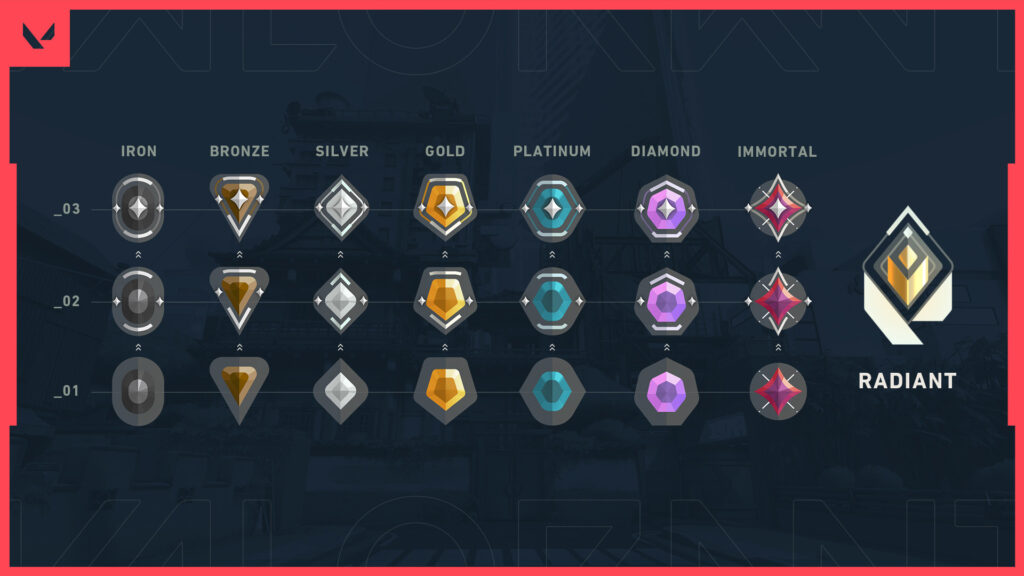
Each rank has 3 levels:
- Iron 1 – 3
- Bronze 1 – 3
- Silver 1 – 3
- Gold 1 – 3
- Platinum 1 – 3
- Diamond 1 – 3
- Ascendant 1 – 3
- Immortal 1 – 3
- Radiant: no tiers. You need your region’s Radiant RR threshold and a spot in the top 500 on your regional leaderboard.
Competitive unlocks at account level 20. At the start of each Season and Mid-Season (Acts 1 and 4) you play 5 placement matches. In the other Acts (2, 3, 5 and 6) you play just 1. The highest rank you can place into is Ascendant 3. Not all ranks can queue together, so check what ranks can play Valorant together before you party up.
Rank Rating And MMR: What’s The Difference?
RR is your visible rating. It goes up when you win and down when you lose. MMR is Riot’s hidden estimate of your skill. It decides who you play with and against, and it scales how much RR each win or loss is worth.
How RR And MMR Change During The Game?
Your result matters most. A win adds RR and a loss takes it away. Below Immortal, Riot also looks at how decisively you won or lost, standout individual plays, and whether you were the underdog. Only your own performance counts, not your teammates’.
Your hidden MMR then scales the result:
- MMR above your rank: bigger RR gains, smaller losses.
- MMR about equal to your rank: gains and losses are roughly even.
- MMR below your rank: smaller gains, bigger losses.
At Immortal and Radiant there is no performance bonus. RR there depends only on wins, losses and round difference. Your hidden MMR carries over, so placements usually put you close to your old rank. After a Season or Mid-Season reset you may land a little lower.
Patch 13.00 (June 23, 2026) adjusted RR calculations so players who win consistently climb faster. On PC, matchmaking now keeps each team’s average rank within 1 sub-tier.
So, How Does Valorant Matchmaking Work?
Riot does not publish the full formula. It uses your hidden MMR, and since Patch 13.00 on PC it also keeps each team’s average rank within 1 sub-tier, so very lopsided lobbies should be rarer.

How To Check Valorant MMR?
You cannot check your MMR. Riot has said it will never be shown. The best clue is your RR per game. If you regularly gain more RR for a win than you lose for a loss, your MMR is likely above your rank. If you lose more than you gain, it is likely below. Third-party trackers that claim to show “MMR” are estimates, not Riot data.
How To Get A Better MMR In Valorant?
Winning ranked matches is the biggest factor in raising your MMR. Playing well in the matches you win, and keeping losses close, helps too. The more victories in your match history, the better and more effective you play, the higher your MMR will be, and the stronger the opponents you will encounter. But for general advice on how to become better in Valorant, I recommend checking out this article. To give yourself an edge, pick strong agents from our Valorant tier list and use a Valorant warm-up routine before ranked.
Enjoy Playing Valorant? Find People Who Share Your Interests!
To improve your Valorant MMR and find yourself in lobbies with increasingly experienced opponents, team performance and communication are of great importance. If you want to play Valorant with people who are truly interested in it, try the Valorant team finder by GameTree.
The GameTree app matches you with players by personality and the games you like. You can also join the GameTree LFG Discord (about 28,500 members, discord.gg/6duvwHx2Q2) and use the Scout bot’s /lfg command to find a Valorant squad.
Final Thoughts
So, what is MMR in Valorant? It’s a hidden rating you get while playing. It’s not disclosed by the developers. Still, Valorant’s matchmaking system is extremely effective and quite accurately evaluates you and matches you with opponents. Valorant’s matchmaking is skill-based, and your hidden MMR is the reason your RR gains change from match to match. Win matches, and not only your rating in the game but also your personal skill will increase. That’s how it works in Valorant.
Frequently Asked Questions
What Is The MMR Rating In Valorant?
MMR is a hidden skill rating that Riot uses to build fair matches. You cannot see it, but it affects how much RR you gain or lose.
How Can I Know My MMR?
You can't. Riot has said it will never show MMR. Watch your RR per game: if wins give you more RR than losses take away, your MMR is likely above your rank.
How Does Valorant Matchmaking Work?
Valorant matches players by hidden MMR. Your MMR also scales how much RR you gain or lose after each match. Since Patch 13.00, PC matchmaking also keeps each team's average rank within 1 sub-tier.
Does Valorant Have Skill Based Matchmaking?
Yes. Valorant's matchmaking system is skill-based. SBMM works well in this game.
Does MMR Reset Each Act?
No. Your hidden MMR carries over. Your visible rank is checked with placement matches: 5 at the start of each Season and Mid-Season, and 1 in the other Acts.
What Is The Highest Rank You Can Get From Placements?
Ascendant 3.