






Why Adults Still Love Games More Than They Admit

If you’ve ever wondered why adults still love games more than they admit, you’re far from alone. Somewhere between paying rent and remembering to buy groceries, most of us decided that play was for children. Yet if you look closely at modern habits, why adults still love games comes down to something much deeper than just killing time. We kept a few exceptions: a poker night, a fantasy league, maybe a puzzle app during a commute. But the idea that grown people might genuinely need to play, not just relax but play, got quietly filed away as something a little embarrassing.
And yet the numbers tell a different story. Adults are gaming more than at any point in recent memory, across more formats, for longer stretches, and with less shame than a decade ago. Mobile titles, tabletop nights, online casinos, story driven console epics, even office trivia apps during lunch breaks. The instinct never left. What changed is how openly people admit it.
Gaming isn’t just for kids anymore, yet many grown-ups keep their late-night gaming sessions on the down-low. If you’ve ever wondered why adults still love games more than they admit, the answer comes down to stress relief, community, and modern storytelling.
How Casino Sites Started Borrowing Video Game Design
Online casino sites have picked up on this instinct too, and it shows in how many of them are built now. Take Crazy Tower casino, where the whole structure is built around climbing floors rather than just spinning reels. It borrows the same progression logic that keeps people hooked on a role playing title: small wins, visible levels, a sense of moving upward. That’s not an accident. It’s a sign that the people designing these sites understand something obvious once you say it out loud: adults respond to play mechanics the same way they did at twelve, they just call it something different now.
Why Adults Still Love Games: The Real Reasons We Keep Coming Back
Ask most people why they still play, and the first answer is usually “to relax.” That’s true, but it’s not the whole picture. There’s a longer, more interesting list underneath it.
- Predictable stakes. Work and relationships come with murky rules and delayed feedback. A round of chess or a level in a puzzle app gives you a clear goal and a clear result, often within minutes.
- Safe competition. Adults rarely get to compete anymore without real consequences attached. A friendly match lets that instinct out without risking a job or a friendship.
- Micro achievement. Finishing a level, beating a personal best, climbing a floor. These small wins hit a part of the brain that daily adult life doesn’t feed nearly enough.
- Nostalgia with new tools. Many popular titles today are just older ideas (matching, climbing, collecting) rebuilt with better graphics and smoother design.
- Social glue. A shared match with friends or coworkers builds connection faster than most small talk does.
one of this is childish. It’s closer to maintenance. The mind needs low stakes wins the same way the body needs stretching.
What the Data Actually Shows
It helps to look past the stereotype of the teenage gamer and check who’s actually holding the controller, or the phone, most nights.
| Age Group | Average Weekly Play Time | Most Common Format |
| 18 to 24 | 8.2 hours | Mobile and console |
| 25 to 34 | 7.5 hours | Mobile and online multiplayer |
| 35 to 44 | 6.1 hours | Mobile and casual apps |
| 45 to 54 | 4.8 hours | Puzzle and card apps |
| 55+ | 3.9 hours | Puzzle and casino style apps |
The drop off with age is real, but it’s smaller than most people guess, and it never reaches zero. Even in the oldest bracket, nearly four hours a week goes toward some form of interactive entertainment. That’s not a fringe habit. That’s a routine.
A breakdown from Statista backs this up, showing that adults in their twenties report the heaviest weekly play among U.S. adults, with a meaningful share logging six hours or more a week. The pattern eases with age rather than disappearing, which lines up with what most people notice in their own circle: the habit doesn’t stop, it just gets quieter.
The Original Blueprint of Play: How Board Games Still Influence Gaming
Before games moved onto screens, board games were already built around the same principles that keep modern players engaged. Chess, strategy games, card games, and cooperative board games all create clear goals, structured challenges, and moments of achievement that appeal to adults as much as younger players. The difference is that board games add a physical and social element: players sit together, read each other’s decisions, negotiate, compete, and create shared memories around the table. In many ways, modern digital games have not replaced traditional play but expanded on the same foundations that made board games popular for generations — progress, problem-solving, competition, and connection.
When looking closely at why adults still love games more than they admit, mental decompression plays a massive role after a stressful workday.
Why We Still Downplay It
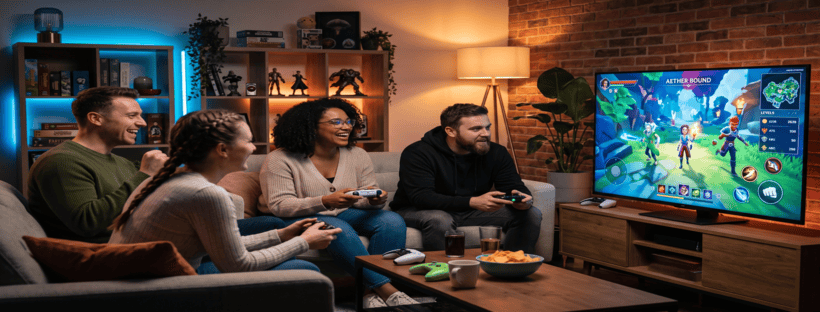
If the habit is this common, why does it still come with a hint of apology? A few patterns show up again and again when people talk about their own play habits.
- They frame it as a guilty pleasure rather than a normal choice, even when it’s no more time consuming than a TV series.
- They separate “productive” hobbies (reading, exercise, learning a language) from “wasted” time, even though both often serve the same stress relief function.
- They downplay competitive titles specifically, worried it signals immaturity, while happily admitting to watching sports for the same competitive thrill.
- They keep certain habits private, mobile games during work breaks, a late night session, an online match, because admitting to them feels like admitting to a lapse in discipline.
The irony is that most of these habits are closer to a coping tool than a flaw. Stress needs an outlet, and a short session of something with clear rules and a clean end point is a reasonable one. Understanding why adults still love games more than they admit helps explain the massive rise in adult gaming communities.
Play as Maintenance, Not Escape
Maybe the healthiest way to think about this isn’t “adults still love games” as if it’s a surprising fact. It’s closer to: adults never stopped needing play, they just found new formats for a very old instinct.
A short match after a long day isn’t avoidable. It’s closer to stretching before a run, a small reset that makes the rest of the day easier to carry. Whether that reset looks like a puzzle app, a card night, or a few minutes on a well designed casino app, the function is the same. It gives the mind a clear goal, a fast result, and a small, honest win.
That’s not something to explain away. It’s something worth admitting to a little more often. When you break down why adults still love games more than they admit, it becomes clear that gaming is simply a modern form of storytelling and decompression
Key Takeaway: Understanding why adults still love games more than they admit proves that gaming has evolved far beyond a hobby for kids.