






20 Best Quiet Classroom Games for Ultimate Student Focus
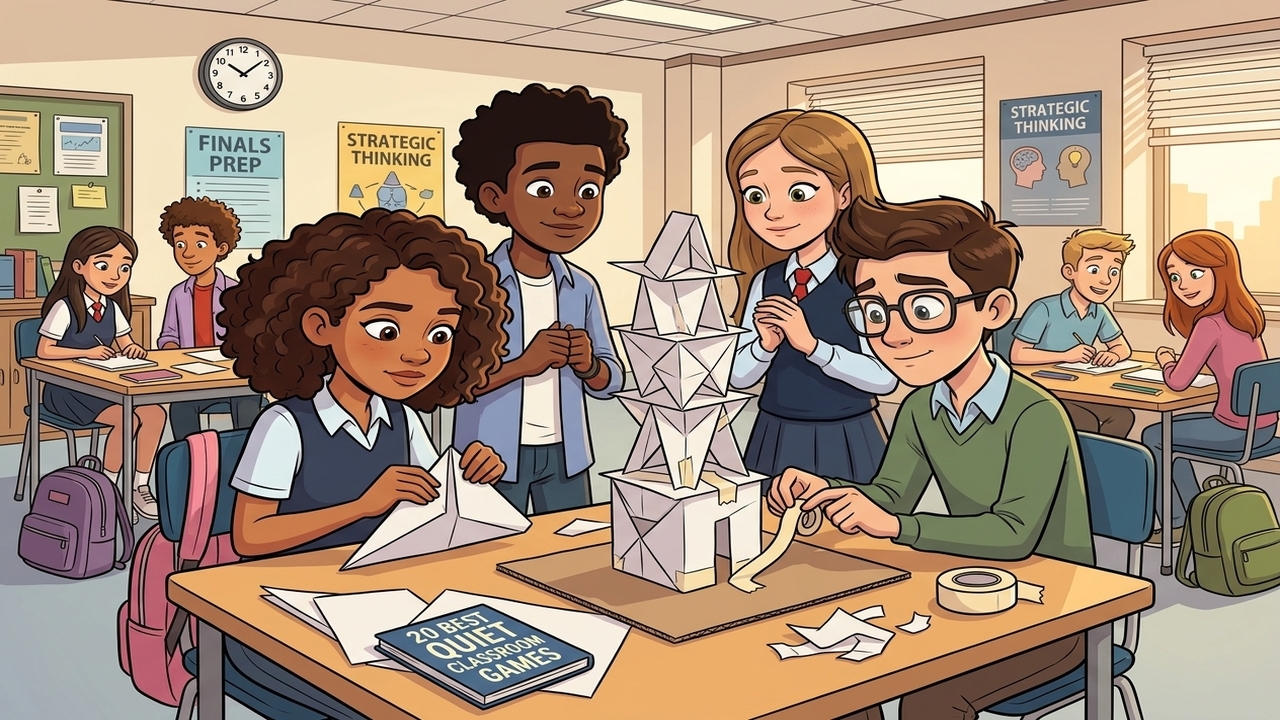
Implementing quiet classroom games right at the beginning of your lesson can completely transform your day.
A noisy learning environment makes it difficult for students to process complex information. Implementing structured quiet classroom games helps manage the ambient volume while keeping your room fully engaged. You do not need to raise your voice to guide the environment effectively.
Excessive noise and long lectures easily contribute to severe academic frustration. When struggling learners feel overwhelmed by the constant academic grind, they might reach a breaking point and decide to pay someone to do my homework just to find some relief. Right now in 2026, finding ways to reduce classroom stress is recognized as a vital step in supporting daily student success.
These activities require absolutely no speaking from the participants. We have categorized these exercises by age appropriateness so you can find the right fit for your specific group. Whether you need elementary brain breaks or advanced logic puzzles for older students, silent play encourages communication through eye contact.
Here are the 20 quiet classroom games we will cover in this guide:
- The silent ball challenge
- Four corners invisible elimination
- The sleeping pirate treasure guard
- The silent mastermind codebreaker
- Silent whiteboard math relay
- Pantomime vocabulary charades
- The whispering statue museum
- Silent heads up seven up
- The invisible ink drawing telephone
- The invisible conductor
- The passing bell circle
- Silent mirror mimicking
- The silent paper tower challenge
- The missing classroom object detective
- Silent pattern block recreation
- The color match scavenger hunt
- The silent speed sorting race
- The dropping pin sound test
- Animal rhythm tapping
- The secret whisper password
Transition and Quiet Classroom Games
Transitioning between subjects often uses up valuable instructional time every single day. Using silent play helps you manage those transitions smoothly without saying a single word.
The silent ball challenge
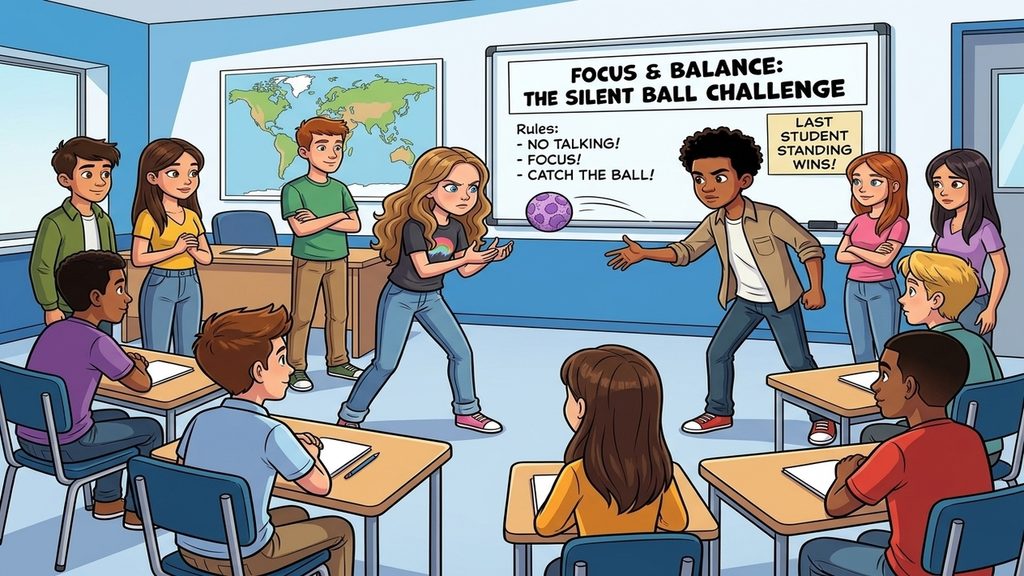
Tossing a soft foam ball around the room demands visual focus from every participating student. If a student drops the ball, talks, or makes a bad throw, they must sit down quietly. The last student standing wins the round.
You should always use a soft object that will not knock items off a desk. Lightweight yarn balls or small beach balls prevent accidental damage and minor injuries.
To make it harder for older children, add these physical rules:
- Stand on one foot during the throw
- Keep one hand firmly behind the back
- Spin in a circle before passing
Four corners invisible elimination
Students silently point to one of four designated corners in the room while one blindfolded student stands in the middle. The blindfolded guesser simply holds up a finger showing a number from one to four. Anyone pointing to that corresponding corner sits down immediately.
This quiet classroom game requires absolutely zero equipment and naturally removes the temptation to whisper. Students enjoy the suspense of waiting for the guesser to reveal the number. The game continues until only one student remains standing.
The sleeping pirate treasure guard
One student sits blindfolded in a chair with a set of keys resting on the floor directly beneath them. Another student attempts to silently sneak up and steal the keys without making a single sound. If the pirate hears movement, they point in the direction of the noise.
If they point directly at the sneaker, that student goes back to their desk empty-handed. This activity helps younger children practice walking quietly around the room. It teaches them exactly how to control their footsteps and maintain physical balance.
Optimal setup parameters for transition activities
| Activity Phase | Suggested Time Limit | Recommended Group Size | Space Required |
| Ball tossing | 5 minutes | Entire class | Desks cleared |
| Corner elimination | 10 minutes | Over 15 students | Open floor |
| Treasure stealing | 8 minutes | Under 20 students | Carpet area |
Academic Quiet Classroom Games
Replacing verbal quizzing with silent visual assessments encourages participation from students who normally shy away from speaking out loud. These educational formats prove that active learning works beautifully in quiet environments. For more resources on structured learning, consider viewing Edutopia’s visual learning guidelines.
The silent mastermind codebreaker
Create a secret sequence of four colored index cards on your desk. A group of students silently places their own cards down to guess the hidden pattern, and you only tap the desk to indicate correct colors in the correct spots. This high-level logic puzzle easily scales up for older adolescents and young adults.
Some of the most fun games for college students involve breaking complex visual ciphers without any verbal communication. When adapting this for adults, you can use complex number sequences or a strict timer to increase the pressure. Ultimately, the best games for college students challenge their critical thinking rather than relying on their physical endurance.
Silent whiteboard math relay
Teams line up in front of the classroom whiteboard to take turns solving steps of a single long-division or algebra problem. Each student can only write one number or symbol before passing the marker to the person behind them. The room remains quiet as teammates eagerly watch for mathematical errors.
If a student spots a mistake made by the previous player, they must use their turn to erase and fix it. This creates a helpful peer-review system without any harsh verbal corrections. Incorporating classroom peer-review routines works beautifully alongside this task.
Pantomime vocabulary charades
Give a student a vocabulary card and ask them to act out the definition using only their body. The rest of the class writes their guesses down on mini whiteboards and holds them up. You simply nod to confirm the correct answers.
This quiet classroom game connects physical movement to language acquisition. It helps kinesthetic learners remember abstract definitions by linking them to concrete physical actions.
Strategy and Logic Quiet Classroom Games
Playing silent logic challenges helps improve a student’s ability to regulate their own impulsive behaviors. The forced quiet removes social pressure, allowing strategic thinking to take over. Seeing students playing games in class in total silence might surprise visiting administrators, but the cognitive benefits are highly valuable.
You can easily adapt many of these into indoor games for high school students by increasing the speed and complexity.
The whispering statue museum
One student plays the museum guard while everyone else freezes completely still like historical statues. When the guard turns their back, the statues can move to new positions, but they must freeze instantly when the guard turns around. Anyone caught moving is sent back to their desk to sit down.
This requires physical self-control and core strength for younger students. It burns off restless energy without adding any auditory chaos to your classroom environment.
Silent heads up seven up
Seven students stand at the front while the rest of the class rests their heads on their desks with one thumb sticking up. The seven chosen students tiptoe around and gently press down exactly one thumb each. Once finished, they return to the front, and the chosen students silently guess who picked them.
This classic quiet classroom game remains a staple because it encourages awareness of subtle environmental clues. Students must listen for a passing shadow or a specific footstep to guess correctly.
The invisible ink drawing telephone
One student traces a simple shape onto the back of the student sitting directly in front of them using their index finger. That student then traces what they felt onto the next person’s back. The final person in the row draws the shape on a piece of paper to see if it matches the original design.
Tactile processing deeply engages the sensory nervous system. It encourages students to sit still and focus entirely on physical sensation.
The invisible conductor
Send one student into the hallway while the rest of the class chooses a secret conductor to lead them in silent actions. The conductor might tap their head, rub their stomach, or mimic playing a guitar. The entire class must quickly copy the conductor without staring directly at them.
Bring the hallway student back inside to observe the group and guess who is leading the movements. This builds peripheral vision skills and group cohesion.
Structural requirements for strategy activities
| Game Category | Clean-up Duration | Teacher Involvement Level | Movement Level |
| Statue freezing | None | Low observer | High bursts |
| Desk guessing | None | Medium facilitator | Minimal |
| Back tracing | 1 minute | Low observer | None |
Emotional Regulation Quiet Classroom Games
Classroom noise often spikes right after recess, requiring dedicated calming exercises to bring the energy back down. Using quiet classroom games after a chaotic lunch period works beautifully for elementary behavior management. It signals the brain that active playtime is officially over.
The passing bell circle
Students sit in a circle and pass a highly sensitive brass bell to the person next to them without letting it ring. This requires slow, deliberate hand movements and focused breath control. If the bell makes even the tiniest sound, it must go back to the starting point.
You can physically see the younger students relax as they focus on the metal object.
Watch for these physical signs of success:
- Relaxed shoulders
- Slower breathing patterns
Silent mirror mimicking
Pair students up facing each other, designating one as the leader and one as the mirror reflection. The leader makes slow, deliberate movements, and the mirror must copy them so closely that an observer cannot tell who is leading. This builds empathy and encourages deep eye contact.
You should switch the leadership roles every two minutes. This prevents frustration and gives both participants a chance to control the creative flow.
The silent paper tower challenge
Hand a small group of older students twenty sheets of scrap paper and a single roll of tape. They have exactly ten minutes to build the tallest freestanding structure possible without whispering a single instruction. This serves as an excellent team-building exercise for older adolescents.
You will frequently see variations of this structural puzzle used as relaxing student lounge games during high school final exam weeks. Working together in total silence naturally lowers stress and fosters mature collaboration.
Visual Memory Quiet Classroom Games
Testing visual memory in silence encourages the brain to rely on spatial mapping rather than verbal repetition. These visual tasks benefit students who sometimes struggle with traditional auditory instruction.
The missing classroom object detective
Ask your students to close their eyes while you remove or relocate one highly visible item in the classroom. When they open their eyes, they must silently scan the room to figure out what changed. When a student knows the answer, they simply put their finger on their nose instead of shouting it out.
This prevents the fastest thinker from spoiling the answer for everyone else. Waiting until several fingers are on noses ensures that a larger portion of the class has solved the puzzle.
Use these specific items for the best results:
- Wall clock
- Whiteboard eraser
- Teacher stapler
- Potted plant
- World globe
Silent pattern block recreation
Build a complex shape using colorful magnetic pattern blocks on the front whiteboard while the class watches in silence. After thirty seconds, cover your design with a piece of opaque paper. The students must then recreate the exact pattern on their own desks using their own blocks.
This tests short-term visual retention and spatial relationship skills. You can easily adjust the difficulty by using more blocks or complex overlapping shapes.
The color match scavenger hunt
Hold up a single colored flashcard and challenge the students to silently walk around the room and touch an object that matches it perfectly. They must find the object and freeze with their finger on it within ten seconds. Running or talking immediately disqualifies them from the round.
Matching subtle shades of color encourages them to look closely at their daily environment. It brings a sense of physical exploration without the usual playground volume.
The silent speed sorting race
Scatter a large deck of playing cards or colored manipulatives across a back table. Students must silently sort the items into perfect categories as fast as humanly possible. They must communicate their sorting strategy to their peers entirely through gestures.
If two students reach for the same item, they must play a silent game of rock-paper-scissors to see who gets it. This creates a peaceful method for conflict resolution during high-stress activities.
Cognitive targets for visual observation activities
| Visual Activity Type | Primary Brain Function | Best Time of Day to Play |
| Object removal | Spatial memory mapping | Morning meeting |
| Block building | Shape and pattern recognition | Math transitions |
| Color hunting | Detailed visual discrimination | Afternoon slump |
| Speed categorizing | Rapid item classification | Before dismissal |
Listening Focus Quiet Classroom Games
Training learners to isolate specific sounds improves their overall auditory processing capabilities. These sensory exercises prompt them to stop making noise so they can finally hear the subtle sounds around them.
The dropping pin sound test
Ask everyone to rest their heads on their desks with their eyes closed tightly. You walk randomly around the room and drop a small paperclip or metal pin onto the hard floor. Students must point exactly to where they think the sound came from without looking up.
This game supports absolute silence because the trigger sound is incredibly quiet. Even the sound of rustling clothing will make it hard to hear the pin drop.
Animal rhythm tapping
Tap out a distinct rhythm on your desk using your knuckles or a pencil. The students must listen carefully and then tap the exact same rhythm back to you in perfect unison. If a single student taps out of turn, the rhythm breaks and the class must start over.
This develops musical timing and group cohesion without any vocalization. It works beautifully as a transition right before a difficult math or science lesson.
The secret whisper password
Stand at the door and require each student to read your lips to figure out a secret password before they can enter the room. You mouth the word with exaggerated lip movements, but you do not use your vocal cords at all. The student must mouth the word back to you correctly to pass.
This immediately establishes a quiet tone before they even cross the threshold. It turns entering the classroom into a highly focused challenge rather than a chaotic stampede
Mastering these quiet classroom games will completely transform your daily teaching routine, turning afternoon chaos into structured calm. When you consistently utilize quiet classroom games throughout the week, you give your students the vital gift of focused, uninterrupted learning. However, your community management skills don’t necessarily have to stop at the classroom door. If you enjoy the coordination and organization required to lead quiet classroom games, you might also manage online gaming communities or Discord servers in your free time. Fortunately, organizing digital players doesn’t have to be as challenging as keeping thirty energetic students completely silent. You can easily automate your server’s matchmaking, player coordination, and group-finding events by integrating the GameTree Discord LFG bot
into your community.
Just as effective quiet classroom games restore peace and order to your physical learning environment, utilizing the right automated tools will restore perfect order to your digital spaces. Let these quiet classroom games be the foundation for a more peaceful, highly organized environment everywhere you lead.