






Distribution Lessons From NuxGame: Why Shipping A Game Isn’t The Same As Reaching Players
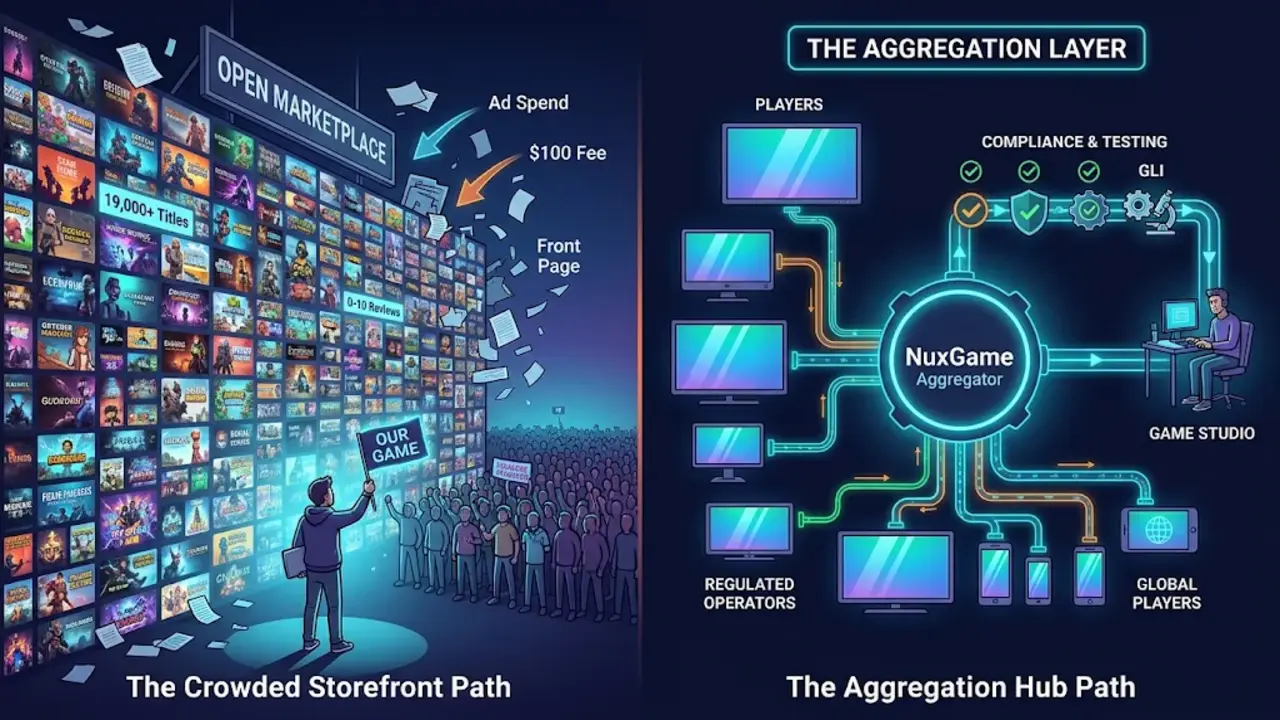
Steam accepted over 19,000 titles in 2025, and approximately 9,000 of those games never got ten reviews. For most studios, that’s the whole problem: the build works, nobody sees it. Elsewhere, games reach players without a store page at all. For a growing number of studios, distribution means an integration and a contract with a platform like NuxGame. There’s a lot more to learn about game distribution from that model than the typical postmortem.
Two Different Paths To A Player’s Screen
On an open marketplace, you are your own publisher. You control the product page, the trailer, the wishlist numbers, and the battle for the store’s front page. Discovery is your product problem, and the main levers you control are your ad spend. A $100 listing fee buys you the right to compete for the store’s front page, nothing more, which is why listing numbers keep rising.
The other path is through an aggregation layer. A studio integrates once with a middleman, after which consumer-facing brands in that middleman’s layer can plug the game into their catalog. NuxGame operates this kind of aggregation layer between studios and regulated real-money gaming operators. Reaching a new audience becomes a configuration change by someone else.
How A Catalog Position Affects A Roadmap
Funds flow differently here. Instead of a sale, you earn a share of what your title generates each month, which gets settled and distributed to you at the end of the month. This means the key metric becomes performance per active player, and titles that underperform get moved out of the main catalog view rather than removed. Your visibility is a merchandising decision that someone renews or doesn’t renew every month.
Of course, this has effects on game design. Each game has to be as small and as tight as possible, and loads have to be as short as possible given the hardware they run on. Anything that requires a tutorial gets cut. Designers rely on player data and telemetry to improve their games, and this data becomes especially critical to commercial conversations. It’s not better or worse than a premium game release, but players notice the difference in design and constraints.
The Cost Of Entry Is Compliance, Not Marketing
Creativity isn’t the constraint here. Titles have to face independent lab testing against technical standards. They have to have different builds and settings depending on the jurisdiction. There are also monthslong delays between the completion of a game and its first appearance in a regulated market. All of these have nothing to do with game design.
Whichever Channel You Use, Habits Worth Stealing
Most things that make a studio viable in the catalog model are easily transferable. These habits are operational and won’t bankrupt a small team the way an unsuccessful launch will. Each habit is worth adopting, regardless of whether you ever partner with an aggregator:
- Schedule instrument sessions on day one. Decide session length, drop point and device. Store this data yourself, not in your partner’s dashboard.
- Optimize your game for a low-end Android device over a slow 3G connection, as opposed to your machine.
- Keep a build that is playable and distributed without your storefront’s SDK. This will allow you to launch a second channel in a week as opposed to months.
- Abstract your code and assets, so you can modify your game for a new market without modifying code.
- Track KPIs to prove your game is performing.
- Retain builds and release notes. Any reviewed channel will ask for these.
- Put a data-export clause in a distribution contract, so the game’s telemetry is returned to you when the contract expires or is terminated.
Telemetry data tells developers stories about their game that they can’t necessarily glean by playing the game, like how a player progresses through a level. The data also tells developers how their game is performing and what players enjoy and don’t enjoy. So, the telemetry is data that developers need to make improvements to their games.
Reach Versus Relationship With Your Players
Distribution contracts solve the distribution problem for small studios, and enable small studios to reach audiences they’d otherwise be unable to reach, at the expense of losing their listing on the store’s webpage, player reviews, player wishlists, and access to player data. Player support requests go to the distributor. The player data also belongs to the distributor. Most players will never know the name of the studio that developed the game.
The burden isn’t evenly distributed. Integration and certification work has been outsourced to the engineering and business development functions, while the community function has more or less ceased to exist, because there is no way to funnel that work. For a 4 person team where the game relies more on mechanics than on its identity, that trade can be rational. For a game whose value is in the group it brings together and the experience players organize around every night, giving up the player relationship is the product.
So, the key question isn’t which channel is more profitable. The correct question is what parts of your relationship with your players do you actually need to keep and is your current distribution model protecting those? If a studio can answer that, then they will be successful whether that distribution model is via a storefront, a platform like NuxGame, or both. This is a question of trade-offs and what costs a studio is willing to take on.
Resources:
https://steamdb.info/stats/releases/ – Steam release volume
https://gaminglabs.com/gli-standards/ – Independent testing standards
https://www.cga.cw/ – Curaçao regulator on supplier licensing