






Playing Alone, Watching Together: What Makes a Game Social?
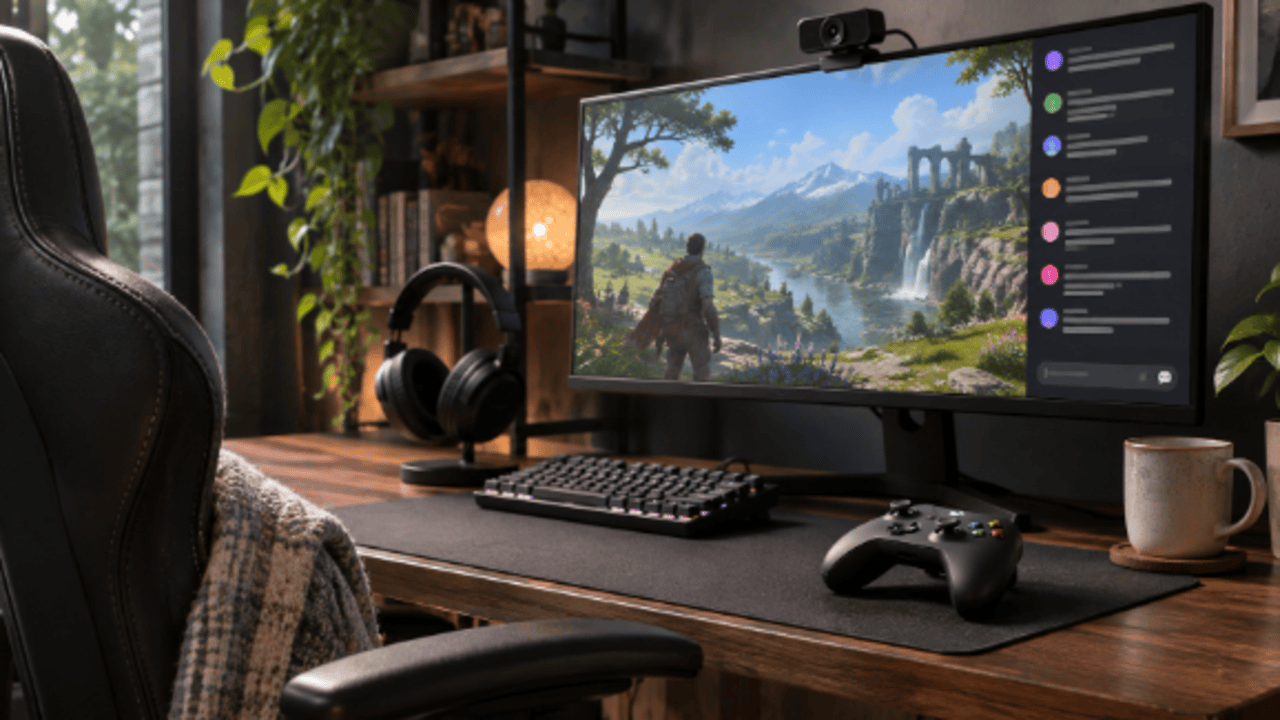
One person has the controller. A friend spots a route they missed, another asks why they chose that weapon, and someone else is laughing about the previous attempt. The game may describe itself as single-player. The evening clearly involves more than one person.
That apparent contradiction disappears when we separate control from conversation. Multiplayer describes how several participants interact with a game’s systems. Social play can also describe the relationships surrounding a session. The two overlap, but neither label tells the whole story.
Who can change the game state?
Start with a practical question: whose input reaches the game? In a cooperative session, several players may move characters and alter the same world. In a screen-sharing session, only the host might have that power. Everyone else can advise, react, or remain quietly present, but those roles do not become equivalent simply because everyone shares a voice channel.
GameTree’s discussion of gaming voice chat options concerns the communication layer around play. That layer can help a team coordinate, but it can also connect people who are playing entirely different things. Hearing a friend’s voice does not require sharing a server, an objective, or even a genre.
Different groups want different amounts of involvement. Some enjoy detailed suggestions. Others prefer company without instructions. Agreeing on whether advice is welcome prevents the familiar situation in which one person thinks they are helping and another feels that every decision has become a committee meeting.
An audience is a separate role
Watching becomes particularly interesting when a game has a clearly bounded round. Spectators can understand the beginning and end even if they have no control over what happens between them. That visible rhythm gives conversation something to gather around, but it does not establish a shared role in the underlying rules.
Casino slots make the distinction unusually clear. A viewer can discuss a symbol combination or ask how a feature works, yet the round remains attached to the individual player’s account and game rules. In the category represented by Jackpot City’s online slots in Canada, an audience’s reactions do not turn an individual reel game into cooperative play. The social activity is the commentary around the event, rather than an additional set of player inputs.
The same distinction helps explain why a lively broadcast and a satisfying multiplayer session require different design work. A broadcast needs moments that viewers can follow. A cooperative game needs meaningful ways for participants to contribute. Adding a chat window addresses only one of those needs.
Give the conversation its own space
A group also needs to decide what kind of presence counts as participation. Constant commentary can exhaust the person playing. Silence can be perfectly comfortable. Someone may join to listen while cooking, then speak when a familiar section appears. Treating every quiet moment as a failure overlooks why people seek company in the first place.
Twitch’s explanation of comments on clips demonstrates another possibility: conversation can continue after the live moment has passed. Replies and reactions attach a social layer to recorded play. People need not arrive at the same time to share an interest in the same moment.
That asynchronous layer has its own etiquette. A comment on a finished attempt cannot guide the player who made it, but it can help someone interpreting the clip later. Labeling a suggestion as a future idea, rather than treating it as an instruction that should already have been followed, makes the exchange easier to receive
Before organizing a session, decide whether the goal is teamwork, an audience, or company. Then choose the tools and expectations that fit. A group does not need equal access to the controls to enjoy being together. It does need a shared understanding of what each person has come to do.