

Pokcas Looks at How Online Games Are Adopting Casino Style Features
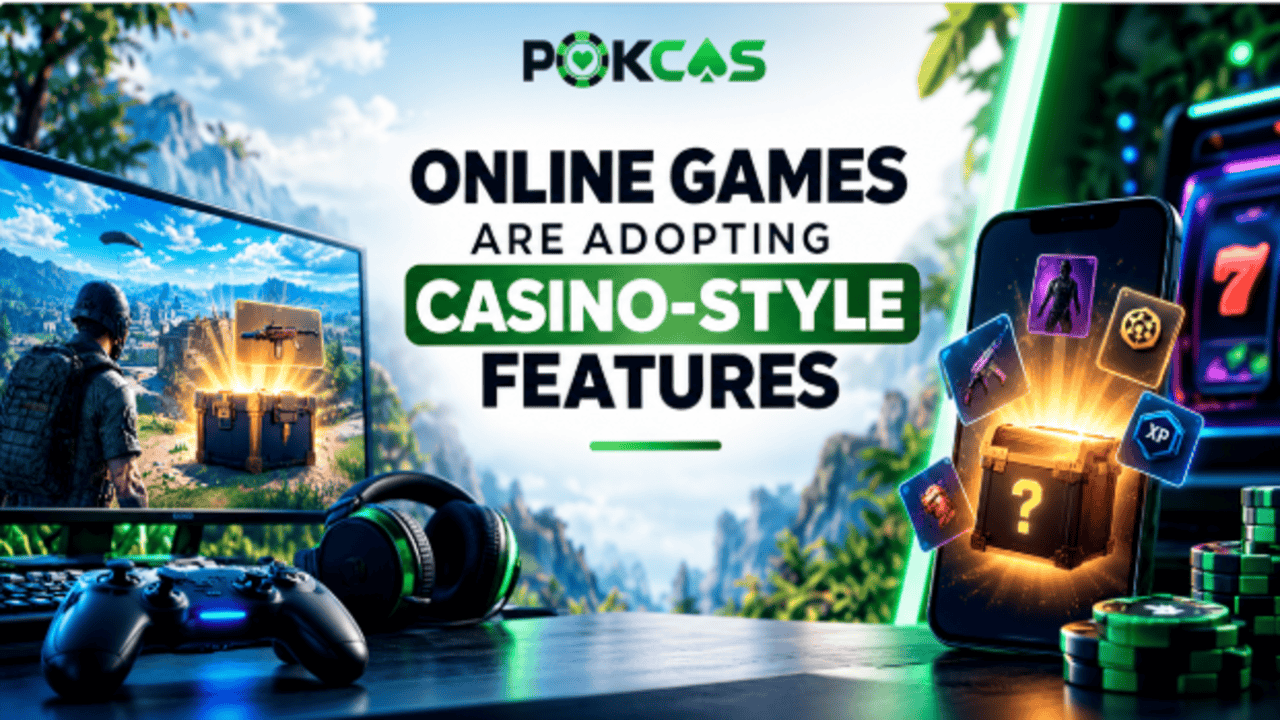
Online games have changed a lot from the days when buying the game gave you access to almost everything inside it. Many of today’s biggest titles are built to keep players coming back for months or even years, supported by seasons, virtual currencies, cosmetic items, battle passes and regularly refreshed rewards
There is serious money behind that model. The global games market generated an estimated $187.7 billion in 2024, according to Newzoo, with mobile gaming alone accounting for roughly half of the total. Free-to-play games have played a major role in that growth because downloading the game is often only the beginning of the player’s spending journey.
Some of the systems used to drive that engagement also look increasingly familiar to anyone who has played casino games. Random rewards, spinning wheels, rarity levels, virtual currencies and limited-time events all introduce an element of anticipation into what happens next.
That doesn’t make Fortnite, Counter-Strike 2 or EA Sports FC casino games. But it does mean the boundaries between different types of online entertainment aren’t as clear as they once were.
The Line Between Online Gaming and Casino Mechanics
The biggest crossover isn’t necessarily about gambling with real money. It’s about how games make rewards feel valuable.
Counter-Strike is a good example. Weapon cases contain items of different rarities, and opening one reveals a randomly selected skin. In EA Sports FC Ultimate Team, packs contain players and other items of varying quality. Other games have used mystery boxes, prize wheels, random character pulls and similar systems.
The player knows a reward is coming. What they don’t necessarily know is which reward they will get.
Several mechanics make that experience work:
- Random outcomes create uncertainty about the reward.
- Rarity tiers make certain characters, skins or items harder to obtain.
- Virtual currencies put an extra step between real money and the purchase.
- Reveal animations turn receiving the reward into part of the entertainment.
- Repeat opportunities allow another attempt almost immediately.
- Limited-time rewards give certain items additional scarcity.
These ideas aren’t exclusive to casinos or video games. Random rewards have existed in physical trading cards for decades. What online games changed was the speed and scale at which players could interact with them.
The similarity becomes easier to see when comparing the mechanics rather than the products themselves. Pokcas, which covers online casinos and casino games, regularly deals with concepts such as randomness, game mathematics and reward structures. Those same ideas can now be found in a very different form across mainstream online gaming.
Random Rewards, Loot Boxes and Chance
Loot boxes are probably the clearest example of casino-style design appearing inside conventional games.
Instead of buying a specific item, the player buys access to a pool of possible outcomes. Some rewards are common. Others may have extremely low drop rates and carry much greater status or perceived value within the game’s community.
That changes the purchase itself.
If a skin costs $10, the decision is simple: is that skin worth $10 to you?
With a random reward, $10 buys a chance of receiving something desirable. Getting an unwanted item doesn’t necessarily end the process either. The player can often purchase another box, pack or roll and try again.
This is where gaming and casino mechanics genuinely start to resemble one another. Both can use probability, anticipation and immediate results to create excitement around an uncertain outcome.
There are important differences, though. Traditional casino games usually involve wagering money for the possibility of receiving money back. Gaming rewards are commonly characters, weapons, cosmetics or other digital items designed to be used inside the game.
Whether it’s a rare Counter-Strike skin, a highly rated Ultimate Team player or the result of a slot spin, randomness changes how players evaluate what they’re spending money on. The product isn’t simply the item anymore. Part of the experience is finding out what happens next.
Why Reward Systems Keep Players Coming Back
Random rewards are only one part of the equation. Online games also use progression systems that give players a reason to return tomorrow, next week or when the next season begins.
The basic idea is simple: playing regularly unlocks more. A player might earn XP toward a new level, complete a daily challenge or move another step through a battle pass. Fortnite helped make the seasonal battle pass model mainstream, while games such as Call of Duty, Apex Legends and Overwatch 2 have adopted their own versions.
Common reward systems now include:
- Daily rewards for logging in or completing specific tasks.
- Battle passes with rewards unlocked across multiple levels.
- Daily and weekly challenges that encourage regular play.
- Streaks that reward consecutive days of activity.
- Seasonal rewards available only during a limited period.
The important difference from a random loot box is that progression usually gives players a clearer target. Complete the challenge, earn the XP and move closer to the next reward.
Casinos have increasingly adopted similar ideas through missions, loyalty levels, tournaments and recurring promotions. The underlying goal is familiar on both sides: give players something to work toward beyond a single game session.
When Virtual Items Have Real Value
A cosmetic skin might exist entirely inside a game, but that doesn’t necessarily make it worthless.
Counter-Strike has demonstrated this better than almost any other game. Skins can be traded through Steam’s marketplace, while a much larger third-party trading economy has developed around rare knives, gloves and weapon finishes. Some particularly scarce items have attracted valuations reaching tens or even hundreds of thousands of dollars.
This creates an unusual digital economy. Players aren’t necessarily opening cases just because they want a different-looking weapon. Rarity, condition, pattern and demand can all affect how desirable an item becomes.
Other games approach virtual value differently. EA Sports FC has its Ultimate Team economy, while Roblox uses Robux and Fortnite uses V-Bucks. These currencies make it possible to buy digital products without displaying a real-money price every time something is purchased.
The systems aren’t identical, but they show how comfortable online players have become with digital items, virtual currencies and accounts containing something they consider valuable.
Learn more about online casinos, casino games and how they work on https://pokcas.com.
When Gaming Mechanics Start Involving Real Money
The biggest distinction appears when real money becomes part of the outcome.
Opening a reward after completing a free challenge isn’t the same as staking money on an uncertain result. Once players are paying for a chance-based outcome, however, understanding the numbers behind the mechanic becomes more important.
Casino games make this particularly clear. Online Slots, roulette and many newer instant games are built around mathematical probabilities. RTP, or return to player, describes the theoretical percentage of stakes a casino game returns to players over a very large number of rounds. A slot with 96% RTP does not guarantee that a player putting in $100 will receive $96 back. Individual sessions can finish far above or below that figure.
The same basic lesson applies more broadly to chance-based online entertainment: a rare outcome being possible doesn’t mean it is likely.
This is where gaming knowledge doesn’t always translate directly into casino knowledge. Being good at Counter-Strike, understanding an in-game economy or knowing how to maximise a battle pass doesn’t change the probability behind a slot spin or another purely chance-based casino game.
As online gaming continues experimenting with random rewards, virtual economies and increasingly elaborate progression systems, the visual gap between gaming and casino entertainment may continue to shrink. The underlying economics, however, can still be very different, and knowing where that difference starts is becoming part of understanding modern online games.