






Rainbow Six Siege Ranks: All 40 Ranks Explained (Ranked 3.0)
-
- Rewritten for Ranked 3.0: 40 ranks, Champion divisions, placement matches, squad restrictions, the Demotion Shield and the Legend Division
- Removed outdated Ranked 2.0 hidden MMR details and Year 10 rank distribution
- Merged the two FAQ sections into one
Author – Darren Buser
Rainbow Six Siege moved to Ranked 3.0 on June 2, 2026, with Year 11 Season 2. There are now 40 competitive ranks: eight tiers (Copper, Bronze, Silver, Gold, Platinum, Emerald, Diamond and Champion), each split into five divisions from V (lowest) to I (highest). Champion used to be a single rank and now has five divisions too, and a separate Legend Division sits above it for the very top players.
Quick Facts:
- Total ranks: 40 (8 tiers, 5 divisions each)
- Entry requirement: Level 50
- Lowest rank: Copper V
- Highest rank: Champion I, with the Legend Division above Champion
- Placements: 5 matches at the start of every season
- Squad limits: within 3 full ranks (Copper to Emerald), within 2 (Diamond and Champion)
- Matchmaking: based on your visible rank (hidden MMR was removed)
Rainbow Six Siege rewards tactical decision-making, operator knowledge and team coordination more than raw aim. Ranked 3.0 also makes the ladder easier to read: the rank on your card is the rank the game uses to find your matches.
Looking for teammates who actually communicate? Climbing ranks in R6 Siege requires coordinated teams that use callouts and strategy. GameTree’s Discord LFG bot helps you find Rainbow Six Siege players who match your playstyle. Just type /lfg Rainbow Six Siege in any Discord server with GameTree installed. No signup required.
What Changed In Ranked 3.0
Ranked 3.0 replaced the Ranked 2.0 system Siege had used since December 2022. The main changes:
- No more hidden MMR. Your visible rank is what matchmaking uses, and how much RP you win or lose depends on the strength of the other team.
- Placement matches are back. Every season starts with five placement matches with boosted RP gains, to get you back toward last season’s level quickly.
- Squad restrictions. For the first time, there are limits on who can queue together in Ranked.
- Champion has five divisions. The top of the ladder is now Champion I.
- Legend Division. A separate ladder above Champion with stricter entry rules.
- Rewards on every match. Each ranked game, win or lose, earns progress on a seasonal rewards track.
All Rainbow Six Siege Ranks In Order
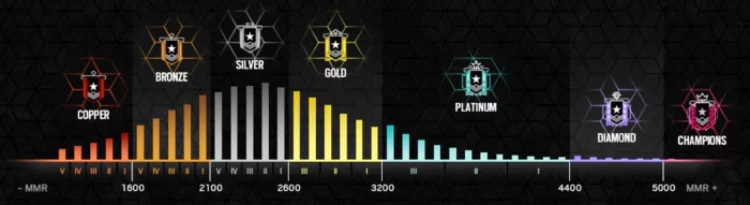
Rainbow Six Siege has 8 rank tiers with 5 divisions each, for 40 ranks in total. Divisions are numbered from V (lowest) to I (highest), so you start a tier at V and move up one division at a time as you earn RP.
| Tier | Divisions | Rank number |
|---|---|---|
| Copper | V, IV, III, II, I | 1 to 5 |
| Bronze | V, IV, III, II, I | 6 to 10 |
| Silver | V, IV, III, II, I | 11 to 15 |
| Gold | V, IV, III, II, I | 16 to 20 |
| Platinum | V, IV, III, II, I | 21 to 25 |
| Emerald | V, IV, III, II, I | 26 to 30 |
| Diamond | V, IV, III, II, I | 31 to 35 |
| Champion | V, IV, III, II, I | 36 to 40 |
What Is Emerald Rank?
Emerald was added in December 2022, between Platinum and Diamond, to split up what used to be a very large skill gap between those two tiers.
The Legend Division
The Legend Division is a separate ladder above Champion for the best players in the game. Ubisoft gave it stricter entry rules to make cheating and account sharing harder at the top of the ladder. To qualify, you need to:
- Currently hold Champion, and reached Platinum or higher in the previous season
- Reach Clearance Level 200 or higher
- Keep a Reputation Standing of 3 or higher
- Turn on two-factor authentication with an authenticator app
- PC players: enable Secure Boot
Legend Division is a separate solo queue above Champion, so it doesn’t count as a 41st rank.
How Rank Points (RP) Work In Ranked 3.0
You climb by earning Rank Points (RP) and drop by losing them. How many you gain or lose depends on the match result and on how your team’s rank compares with the other team’s:
- Beat a higher-ranked team and you gain more RP
- Lose to a lower-ranked team and you lose more RP
- Your post-match report shows how much RP each game earned or cost you
How Mixed-Rank Squads Are Rated
When a squad has a big rank gap, the game weights the team toward its highest-ranked player instead of using a simple average. A Diamond queuing with Platinum friends pulls the whole squad’s rating up, so expect tougher opponents.
Demotion Shield
If a loss would drop you into the division below, the Demotion Shield can hold you at 0 RP in your current division instead. It only applies if you started that match above 0 RP.
What Ranks Can Play Together In Rainbow Six Siege?
Ranked 3.0 added squad restrictions. After your placement matches, you can only queue with teammates who are close to your rank:
- Copper to Emerald: teammates within three full ranks of you
- Diamond and Champion: teammates within two full ranks of you
Placement matches have no squad restrictions, so you can play your first five games of the season with anyone.
Finding Teammates In Range
Because of these limits, climbing as a squad means finding regular teammates near your own rank.
Looking for teammates at your actual skill level? GameTree’s Discord LFG bot helps you find Rainbow Six Siege players who match your rank and playstyle. Type /lfg Rainbow Six Siege Gold (or your rank) in any Discord server with GameTree installed to find appropriately skilled teammates who communicate and coordinate.
Seasonal Rank Reset and Placement Matches
Rainbow Six Siege seasons last about three months. At the start of each one, everyone plays five placement matches before getting a rank. RP gains are boosted during placements, and your starting rank is aimed at where you finished the previous season, so you don’t have to grind up from Copper V again.
What Carries Over
- Your rank resets and is set again by your placement matches
- Your operators, cosmetics and account progression stay
- Seasonal rank rewards you earned stay on your account
Rainbow Six Siege Ranked Rewards
Ranked 3.0 gives you rewards in two ways.
The Seasonal Rewards Track
Every ranked match earns reward points: 2 for a win and 1 for a loss. You unlock a reward every 10 points, up to 150 points. Rewards along the track include Competitive Coins, Alpha Packs, a card background, a charm and, at 150 points, a headgear.
Rank Rewards
Rank rewards are based on the highest rank you reach during the season, and you keep them even if you drop later in the season.
How To Rank Up Fast In Rainbow Six Siege
Climbing ranks in Rainbow Six Siege requires more than just good aim. The game heavily rewards tactical knowledge, team coordination, and operator mastery over raw mechanical skill.
1. Master Map Knowledge (Most Important)
Ranked uses a Pro Pool of maps plus a few Seasonal Pool maps that change every season, and you ban maps before each match. Knowing these maps inside and out provides more advantage than any other single skill:
What To Learn:
- Objective locations: All bomb site positions and their names (e.g., “Kitchen/Dining” on Chalet)
- Callouts: Room names and location terminology your teammates use
- Rotation holes: Where to create holes between bomb sites for efficient movement
- Camera positions: All default camera spawns (attackers and defenders)
- Vertical gameplay: Which floors can be destroyed to shoot through
- Entry points: All windows, doors, hatches, and breach points attackers can use
- Hiding spots: Common angles where defenders hold and attackers push from
Practice Method:
- Load into Training Grounds (formerly Terrorist Hunt) solo
- Walk through each map for 15-20 minutes without combat
- Use drones to explore every room and memorize callouts
- Watch YouTube guides for advanced vertical plays and rotation strategies
- Play each map 10+ times in casual before taking it to Ranked
Reality Check: A Silver player with excellent map knowledge will outperform a Gold player with poor map knowledge every time. This is the #1 differentiator between ranks in Rainbow Six Siege.
2. Communicate Constantly (Use Voice or Text Chat)
Rainbow Six Siege is fundamentally a team-based tactical shooter. Solo fraggers who don’t communicate often stall in the middle ranks, whatever their aim.
Essential Callouts:
- Enemy positions: “Two enemies Kitchen, one rappelling window”
- Operator identification: “Thermite pushing garage, burned both walls”
- Utility status: “My ADS is down, don’t push yet”
- Death information: “Dead to Bandit below me, he’s hurt”
- Action plans: “Let’s execute onto B, I’ll breach wall, you frag out”
Pro Tip: Keep callouts concise and factual. “Ash on white stairs, low HP” is infinitely more useful than “OMG SHE’S OVER THERE SHOOT HER!!!”
Finding communicative teammates: Random solo queue often results in silent teammates. For consistent communication, use GameTree’s Discord LFG to find players who mic up and coordinate strategies. Type /lfg Rainbow Six Siege [your rank] voice chat to specifically find teammates who communicate.
3. Play Meta Operators (Don’t One-Trick)
Each season introduces operator balance changes that shift the meta. Playing weak or off-meta operators creates unnecessary handicaps.
Strong picks in Year 11 Season 3 (Operation Split Fire), based on where recent tier lists agree. The meta shifts with every patch, so check the latest designer’s notes:
Attack (Most Impactful):
- Ace / Thermite: hard breach to open reinforced walls
- Thatcher / Maverick: get past defender wall denial
- Nomad: watch flanks and protect the plant
- Grim / Solid Snake: popular picks for intel and pressure this season
Defense (Most Impactful):
- Mute / Kaid: deny hard breach on reinforced walls
- Azami / Smoke: block angles and deny areas, especially after the plant
- Jäger: ADS that destroys attacker utility
- Mira / Fenrir: one-way windows for intel and fear traps to slow pushes
Operator Learning Priority:
- Master 2-3 operators per role (attack/defense)
- Ensure you can play at least one hard breacher (attack) and wall denial (defense)
- Learn operators with simple but impactful utility (Thermite, Mute, Sledge)
- Gradually expand your pool as you understand team composition needs
4. Drone Efficiently and Preserve Intel
Rainbow Six Siege is an information-based game. Teams with better intel win more rounds, regardless of mechanical skill differences.
Drone Usage Tips:
- Prep phase: Don’t rush your drone into objective. Park it safely in adjacent rooms for later
- Before pushing: Always drone yourself in. Never enter a room blind
- Teammate drones: Ask teammates to drone you in while you push (you can’t shoot while droning)
- Preservation: Hide drones in corners/rafters where defenders won’t check
- Post-death: Drone for alive teammates after you die (stay useful)
Camera Management (Defense):
- Valkyrie cams: Place in unexpected spots (not obvious corners)
- Default cams: Don’t spam ping. Use voice callouts instead (pinging reveals camera)
- Observation mode: Rotate through cams during prep phase to spot attacker spawn locations
5. Manage Your Economy (Utility > Gadgets)
Rainbow Six Siege operates on a “utility economy” where teams that waste gadgets early lose rounds late.
Attack Utility Priority:
- Hard breach charges: Use only when necessary; don’t waste on soft walls
- Flash/stun grenades: Save for actual pushes, not random throws
- Frag grenades: Hold for post-plant or known defender positions
- Smoke grenades: Critical for planting or reviving teammates safely
Defense Utility Priority:
- Reinforcements: Coordinate with team; don’t reinforce rotation holes
- Barbed wire: Place in doorways and common entry routes
- Bulletproof gadgets: Use them to block lines of sight or protect rotation holes
- ADS/Mag-Net: Place near key walls or positions to burn attacker grenades
6. Improve Mechanical Aim (But Don’t Overvalue It)
While aim matters less in Rainbow Six Siege than CS2 or VALORANT, you still need competent gunplay to win firefights.
Aim Training Routine:
- Training Grounds: 10 minutes daily eliminating AI terrorists (headshot only)
- Crosshair placement: Always pre-aim at head height, not floor
- Leaning mechanic: Quick-peek corners by leaning while ADS
- Recoil control: Learn first 10 shots of your main operators’ weapons
- Sensitivity: Find consistent sens that allows tracking + flicks (most pros use 400-800 DPI, 8-15 in-game)
Reality Check: A player with Diamond-level aim but Silver-level map knowledge will place in Gold. A player with Gold-level aim but Diamond-level map knowledge will place in Platinum. Prioritize tactics over aim.
7. Learn From Defeats (Review and Adapt)
Every loss provides information about your weaknesses. Top players actively analyze their mistakes rather than blaming teammates.
Post-Match Review Questions:
- Why did we lose that round? (Utility waste, poor positioning, bad trade, etc.)
- What operator pick would have countered their strategy?
- Where did I die and why? (Positioning mistake, bad angle, failed drone check?)
- Did we communicate our plans clearly before executing?
- What can I personally improve for next match?
High-rank players take responsibility for their own performance rather than fixating on teammate mistakes. Focus on what you can control.
Common Mistakes That Prevent Ranking Up
1. Roaming Without Coordination (Defense)
Mistake: Playing Caveira/Vigil/Ela and roaming alone without communicating with teammates.
Why It Fails: Coordinated attackers drone you out, you die early, and your team fights 4v5 on site.
Solution: If roaming, tell your team your position and rotate back to site BEFORE you’re the last alive.
2. Rushing Without Intel (Attack)
Mistake: Ash/Zofia players sprinting into building 10 seconds into round without droning.
Why It Fails: You run into pre-aimed defenders and die immediately, wasting utility.
Solution: Drone first, identify defender positions, then push with teammate support.
3. Not Playing Objective (Both Sides)
Mistake: Hunting for kills across the map while objective is being contested.
Why It Fails: Rainbow Six Siege rewards objective play. You can go 12-2 K/D and still lose 0-4 if you never touch objective.
Solution: Kills are means to an end (securing objective), not the goal itself.
4. Solo Queue Without Communication
Mistake: Playing ranked without voice chat or text communication in solo queue.
Why It Fails: Rainbow Six Siege is fundamentally team-based. Silent players often stall in the middle ranks.
Solution: Use voice chat in solo queue OR find a coordinated 5-stack through GameTree’s Discord LFG.
5. Ignoring Operator Bans
Mistake: Not considering what operators get banned and adjusting your strategy accordingly.
Why It Fails: If Thatcher is banned and you have no alternate hard breach denial counter, you lose entire rounds.
Solution: Learn multiple operators per role so you can adapt to ban phase.
6. Toxic Behavior and Tilting
Mistake: Blaming teammates, typing in chat, getting angry after bad rounds.
Why It Fails: Tilting destroys team morale and prevents you from focusing on your own gameplay.
Solution: Mute toxic players immediately. Focus on what you can control. Take breaks after 2-3 losses.
Crossplay and Cross-Progression in Rainbow Six Siege
Yes, PC and console players can play together in Rainbow Six Siege, and have been able to since Year 9 Season 4 (December 2024). Crossplay is always on for PC. On console it’s off by default, and you can turn it on in Options. If a squad includes a PC player, it plays in the PC pool.
Crossplay Support:
- ✅ PlayStation ↔ Xbox (console crossplay)
- ✅ PC ↔ Console (console players opt in; off by default on console, always on for PC)
- ✅ Separate ranks for the PC pool and the console pool
Cross-Progression: When your platforms are linked to the same Ubisoft account, your operators, cosmetics, Renown and Battle Pass progress carry over everywhere. Your rank is the exception: you have one console rank and a separate PC rank.
For step-by-step instructions on turning crossplay on and linking your platforms, read our Rainbow Six Siege crossplay guide.
Rainbow Six Siege Mobile: Ranked on the Go
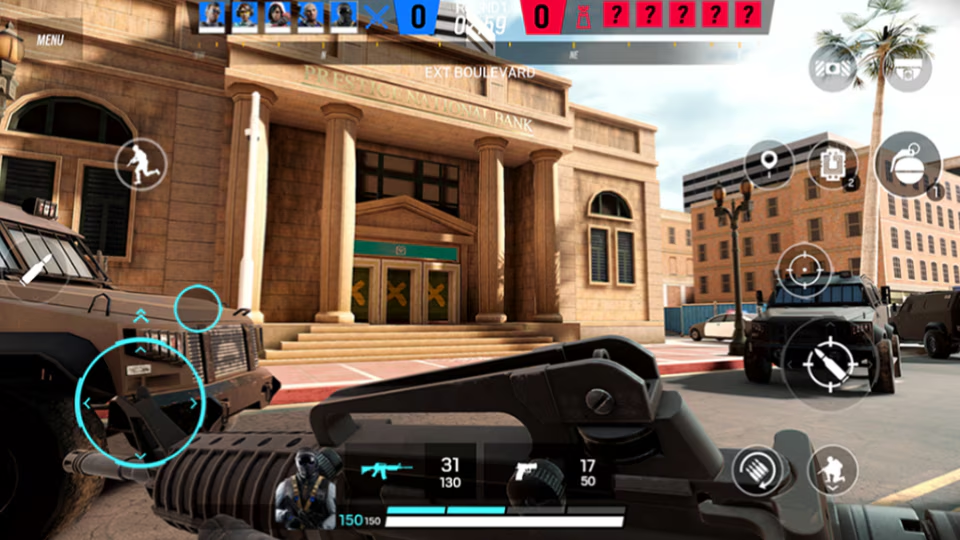
Ubisoft is developing Rainbow Six Siege Mobile, a mobile adaptation featuring a separate ranked system optimized for touchscreen controls. While the mobile version shares operators and maps with the main game, it operates as a standalone title with its own competitive ladder.
Key Differences:
- Controls: Simplified for touchscreen (aim assist, contextual actions)
- Maps: Smaller versions of classic maps optimized for mobile performance
- Progression: Separate ranked system; progress doesn’t transfer from PC/console
- Operators: Gradual rollout of operators from main game
For release date information, pre-registration details, and gameplay differences, check our Rainbow Six Siege Mobile guide.
Final Thoughts: The Climb to Champion
Rainbow Six Siege’s 40-rank ladder from Copper V to Champion I represents one of competitive gaming’s most rewarding grinds. Unlike shooters where mechanical aim dominates, Siege rewards tactical knowledge, team coordination, operator mastery, and map understanding over raw gun skill.
Ranked 3.0, with one visible rank, placement matches and squad limits, makes matchmaking easier to understand while keeping the seasonal grind that keeps players engaged. Whether you’re aiming for Gold, Platinum, Diamond, or the elusive Champion rank, remember:
- Map knowledge > Aim skill in Rainbow Six Siege
- Communication wins rounds more than solo fragging
- Learn from defeats rather than blaming teammates
- Master 2-3 operators per role before expanding your pool
- Play with coordinated teammates who communicate
The grind from Bronze to Champion isn’t about getting lucky. It’s about mastering the game’s tactical depth, improving consistently, and building synergy with teammates who share your competitive mindset.
Ready to climb with a coordinated squad? Solo queue is a grind, but GameTree’s Discord LFG bot makes finding quality teammates instant. Type /lfg Rainbow Six Siege in any Discord server with GameTree installed to match with players at your rank who communicate, coordinate, and want to win as much as you do.
Good luck on the ranked ladder, operator. See you in Champion.
Frequently Asked Questions
How Many Ranks Are There In Rainbow Six Siege?
There are 40 ranks under Ranked 3.0: eight tiers (Copper, Bronze, Silver, Gold, Platinum, Emerald, Diamond and Champion), each with five divisions from V to I.
What Is The Highest Rank In Rainbow Six Siege?
Champion I is the highest rank. Above Champion sits the Legend Division, a separate solo queue for qualified top players with stricter account security rules.
What Is The Lowest Rank In Rainbow Six Siege?
Copper V is the lowest rank.
Do Ranks Reset Every Season?
Yes. Every season starts with five placement matches with boosted RP gains, and your starting rank is aimed at where you finished last season.
What Ranks Can Play Together In Rainbow Six Siege?
After placements, Copper to Emerald players can queue with teammates within three full ranks, and Diamond and Champion players within two. There are no squad restrictions during placement matches.
Can You Lose Your Rank?
Yes. Losing RP can drop you into a lower division. The Demotion Shield can hold you at 0 RP instead of demoting you, but only if you started that match above 0 RP.
How Do I Check My MMR In R6?
You don't need to. Ranked 3.0 removed hidden MMR, so the rank on your card is the rank matchmaking uses.
Do You Need Level 50 To Play Ranked?
Yes. You need to reach Level 50 before you can play Ranked.
How Do I Rank Up Quickly In Rainbow Six Siege?
Win against higher-ranked teams, which pays more RP, and play with a regular squad near your rank. The tips above on map knowledge, communication and droning matter more than raw aim.
What Is The Legend Division?
A separate ladder above Champion for the very top players. To qualify you need to currently hold Champion, have reached Platinum or higher in the previous season, reach Clearance Level 200 or higher, keep a Reputation Standing of 3 or higher, and turn on app-based two-factor authentication. PC players also need Secure Boot enabled.