

Fortnite Ranks 2026: All Ranks Explained (Bronze to Unreal)
-
Added information about ranks reset
-
Added insights from professional Fortnite competitors
-
Content updated as of the beginning of 2025
Updated – January 15, 2026
Author – Darren Buser
Fortnite’s ranking system provides players with a clear competitive ladder, from Bronze through to the prestigious Unreal tier. With Chapter 7 Season 1 now live and Ranked 2.0 changes rolling out, Epic Games continues refining how players prove their skills in Battle Royale and Zero Build modes. Whether you’re grinding your first placement matches or pushing for that elusive Unreal rank, understanding how the system works is essential for climbing efficiently.
This guide breaks down all eight Fortnite ranks, explains how progression works in 2026, covers the latest Ranked 2.0 updates, and shares strategies for ranking up faster. We’ve also included current rank distribution data so you can see exactly where you stand among the 4.7 million+ players competing in ranked mode.
Looking for teammates to grind ranked with? Climbing solo can be brutal when random fills won’t communicate or coordinate rotations. GameTree’s Discord LFG bot helps you find Fortnite players who actually use mics and understand endgame strategy. Just type /lfg Fortnite in any Discord server with GameTree installed.
Quick Overview: How Fortnite Ranked Works in 2026
Fortnite’s ranked system uses skill-based matchmaking to pair you with players at similar skill levels. Unlike non-ranked matches, where you can drop into any lobby, ranked mode tracks your performance through a hidden MMR (Matchmaking Rating) system combined with visible rank tiers.
Key mechanics:
- Performance-based progression – Eliminations, placement, and survival time all contribute to rank gains
- Two separate ranked modes – Battle Royale (with building) and Zero Build each have independent rankings
- Seasonal resets – Ranks reset at the start of each new season, though your placement depends on previous performance
- No rank decay – You won’t lose rank from inactivity, but seasonal resets keep the ladder competitive
After playing several ranked games, your visible rank adjusts based on performance. The biggest change since 2025 was Epic Games’ shift toward holistic performance metrics rather than pure elimination-based progression. Damage dealt, team support in duos/trios, objective control, and smart positioning now factor into your rank gains more heavily than previous seasons.
All Fortnite Ranks: Complete Tier List (2026)
Fortnite features eight ranks with 18 total tiers that players progress through. These Fortnite ranked levels determine your position on the competitive ladder and which opponents you’ll face in matchmaking.
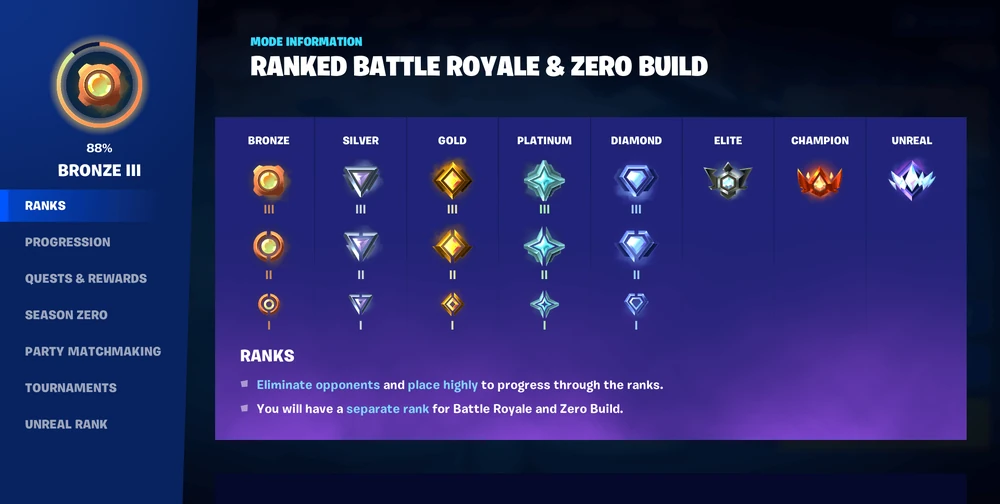
1. Bronze (3 Tiers)
Population: ~21% of all ranked players
Tiers: Bronze I → Bronze II → Bronze III

Bronze is the starting point for new competitive players. Most matches here feature players still learning core mechanics like building under pressure, rotation timing, and inventory management. The skill gap is wide – some Bronze players are genuinely new while others are climbing back after seasonal resets.
How to escape Bronze:
- Focus on consistent top-10 placements rather than chasing every elimination
- Learn basic building patterns (box fighting, simple high ground takes)
- Study the map to identify safe rotation paths and high-loot areas
- Avoid hot drops unless you’re confident in early-game fights
2. Silver (3 Tiers)
Population: ~30% of all ranked players (most populated division)
Tiers: Silver I → Silver II → Silver III

Silver I is the single most common rank in Fortnite, with roughly 9.9% of the entire ranked player base sitting here. Silver players understand basic mechanics but struggle with consistency. You’ll see decent building, tactical awareness, and intentional loadout choices, but mistakes still happen frequently.
What separates Silver from Gold:
- Material management – Running out of mats mid-fight is common in Silver but rare in Gold
- Editing speed – Silver players can edit but often hesitate; Gold players chain edits smoothly
- Endgame positioning – Understanding zone rotations before they close becomes critical
3. Gold (3 Tiers)
Population: ~23% of all ranked players
Tiers: Gold I → Gold II → Gold III

Gold marks the transition from casual competitive to serious ranked play. Players here have solid game sense, understand meta loadouts, and rarely make unforced errors. Competition tightens significantly – every player knows how to build, edit, and pressure effectively.
Gold plateau challenges:
- Most players get stuck between Gold II and Gold III because the skill jump to Platinum is steep
- Third-partying becomes common; good players capitalize on ongoing fights
- Zone awareness matters more than mechanical skill at this tier
4. Platinum (3 Tiers)
Population: ~14% of all ranked players
Tiers: Platinum I → Platinum II → Platinum III

Platinum players are mechanically proficient and tactically sharp. You’ll face opponents who can box fight efficiently, make calculated aggression plays, and exploit positioning mistakes ruthlessly. Reaching Platinum puts you in the top 25% of all ranked players.
What you need to climb out of Platinum:
- Advanced building/editing – Triple edits, fast resets, and creative high ground retakes
- Optimal loadouts – Knowing which weapons to prioritize and when to swap
- Endgame IQ – Understanding storm surge, positioning for rotating zones, and when to disengage
5. Diamond (3 Tiers)
Population: ~8% of all ranked players
Tiers: Diamond I → Diamond II → Diamond III

Diamond represents high-level competitive play. These players have thousands of hours invested and treat ranked like tournament practice. Reaching Diamond I puts you in the top 13% globally. Opponents will piece control aggressively, punish peeking mistakes instantly, and track your movement patterns.
Diamond gameplay characteristics:
- Lightning-fast edits and resets during build fights
- Strategic use of utility items (shock grenades, crash pads) for outplays
- Discipline to avoid unnecessary fights that burn resources
6. Elite
Population: ~2% of all ranked players
No tiers – Single division

Elite is where serious competitors land. This rank requires consistent top-tier performance across dozens of matches. Once you reach Elite, you cannot be demoted for the rest of the season. You’re locked in regardless of future performance.
Elite qualification requirements:
- Exceptional mechanical skill and game sense
- Ability to win fights while conserving mats and health
- Understanding when to W-key versus when to play passive
7. Champion
Population: ~1% of all ranked players
No tiers – Single division

Champion players are tournament-caliber. Many have competed in FNCS qualifiers or Cash Cups. Like Elite, Champion rank cannot be lost once achieved during a season. Reaching this tier often requires playing with a consistent duo or trio that understands competitive meta strategies.
What separates Champion from Elite:
- Consistent ability to place top 5 in stacked lobbies
- Mastery of midgame rotation and zone control
- Understanding how to play for points in tournament-style scoring
8. Unreal
Population: <0.5% of all ranked players
No tiers – Highest rank achievable

Unreal is Fortnite’s pinnacle rank. Only the absolute best players reach this tier. We’re talking top 0.5% globally. Unreal players often stream, compete professionally, or have thousands of hours perfecting their craft. Once you hit Unreal, you’re locked in for the entire season and qualify for major competitive events.
Current Unreal requirements (Chapter 7 Season 1):
- Must reach this rank by specific tournament deadlines to qualify for events like the Unreal Cup
- Requires mastery of every game mechanic and deep meta knowledge
- Typically achieved by players with 3,000+ hours in competitive Fortnite
Ranked 2.0: What’s Changing in 2026
At the 2025 Fortnite Global Championship, Epic Games teased Ranked 2.0, a complete overhaul of the competitive ranking system. While full details are still rolling out, here’s what we know so far:
Performance-Based Progression (Not Just Eliminations)
The biggest shift is moving away from pure kill-focused ranking. Ranked 2.0 emphasizes overall match performance:
- Damage dealt – Contributing to fights even without securing eliminations
- Team support – In duos/trios, assists and covering teammates factors into gains
- Objective control – Zone positioning, rotating efficiently, and playing for endgame
- Survival time – Lasting longer in matches matters more than farming kills early
This change addresses community feedback that the old system rewarded aggressive W-keying over smart tactical play. Players who consistently place top 10 with moderate kills will now progress similarly to those who hot drop for 10+ eliminations but die mid-game.
Better Matchmaking with Hidden MMR
Epic Games refined the hidden MMR system that runs alongside visible ranks. This prevents situations where:
- Smurfs dominate lower ranks with alternate accounts
- Players who took breaks return to their true skill level faster
- Rank inflation/deflation balances itself across the season
Your hidden MMR tracks your actual skill independently from visible rank, meaning matchmaking places you against fair competition even if your displayed rank doesn’t perfectly reflect ability.
Competitive Division System for FNCS
Starting with FNCS 2026 (launching January 31, 2026), Epic introduced a new Division-based competitive structure:
- Players compete in FNCS Trial to get placed into divisions
- Only Division 1 players can enter FNCS Major tournaments
- Divisional Cups replace older Cash Cup qualification systems
- This creates a clearer ladder for aspiring pro players
For casual-ranked grinders, this means the path to competitive Fortnite is now more transparent. Reaching Champion or Unreal automatically qualifies you for Division 1 Cups, which feed into Major qualifiers.
Understanding the Fortnite Ranked Point System
Fortnite’s ranking system combines visible rank points with a hidden MMR to determine progression. Here’s how the Fortnite ranked point system actually works:
Earning Rank Points
After each match, you gain or lose rank percentage based on:
- Final placement – Top 25, top 10, top 5, Victory Royale
- Eliminations – Each elimination awards points (diminishing returns after 5+)
- Survival time – Lasting longer increases point multipliers
- Hidden MMR adjustments – Playing against stronger opponents earns more points
Important: You don’t see exact point totals. Instead, your rank bar fills up as a percentage. Typically, 3-6 wins at average performance will promote you one tier (e.g., Gold II to Gold III), but strong performances can accelerate this.
The Hidden MMR System
Epic Games uses a hidden Matchmaking Rating that operates behind the scenes:
- Your MMR tracks true skill level independently from visible rank
- Matchmaking pairs you with players of similar MMR, not necessarily identical ranks
- This prevents rank inflation and ensures competitive fairness
Example: If you’re Gold II but play like Platinum I (high MMR), you’ll:
- Face tougher opponents than typical Gold II players
- Gain more rank percentage per win
- Climb faster toward your “true” rank
Conversely, if you’re Gold II with Bronze-level MMR (maybe from inactivity), you’ll:
- Face easier opponents temporarily
- Gain less rank percentage per win
- Stabilize at the rank matching your actual skill
Seasonal Resets: How Placement Matches Work
At the start of each new Fortnite season (every ~90 days), ranks reset. However, you don’t drop all the way back to Bronze I. Instead:
- Placement matches – Your first 5-10 ranked matches re-calibrate your starting rank
- Previous season performance – If you ended Platinum III, you might start Gold I or Gold II
- Hidden MMR carries over – Your true skill rating doesn’t fully reset, just compresses
Your initial rank after a reset depends on your previous finish. Chapter 7 Season 1 launched November 29, 2025, and runs until March 4, 2026. Players who reached high ranks in Chapter 6 Season 4 started this season several tiers below their ending rank but climbed faster due to preserved MMR.
Battle Royale vs Zero Build: Which Ranks Faster?
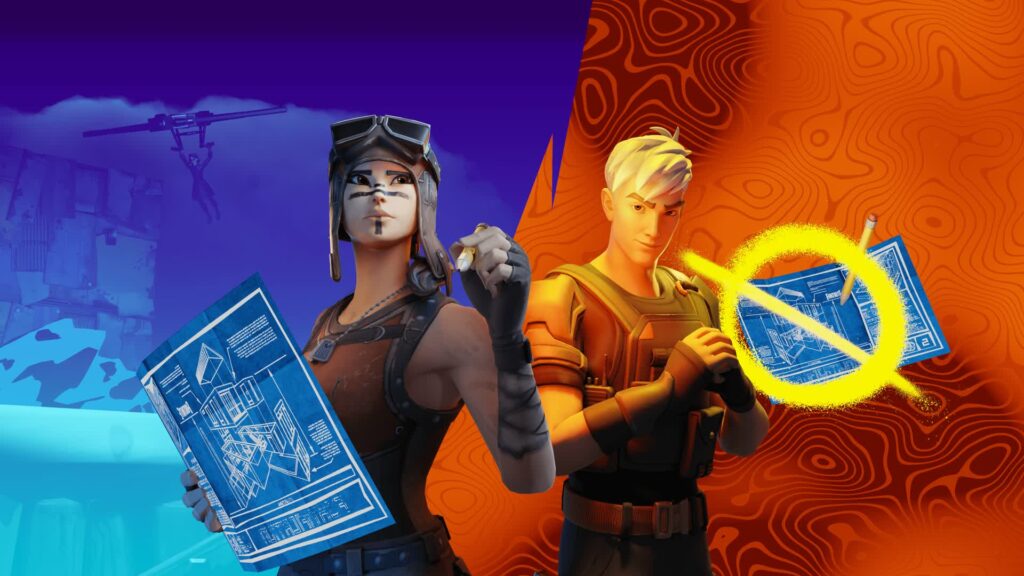
Fortnite offers ranked mode for both Battle Royale (with building) and Zero Build (no building). Each mode maintains separate rankings and has distinct player populations:
Battle Royale Ranked
- Average rank: Gold I/Gold II
- Player population: ~4.7 million active ranked players
- Skill ceiling: Higher due to building mechanics
Battle Royale attracts hardcore players who’ve mastered building. The average player sits around Gold I, meaning there’s a healthy distribution across all ranks. If you’re comfortable with edits, resets, and build fights, this mode offers faster progression for mechanically skilled players.
Zero Build Ranked
- Average rank: Silver II
- Player population: ~1 million active ranked players
- Skill ceiling: Lower but emphasizes positioning and aim
Zero Build appeals to newer players or those coming from other shooters without building mechanics. The average rank is lower (Silver II) because the player base skews more casual. However, skilled players from games like Apex Legends or Warzone can climb rapidly since gunplay and positioning translate directly.
Which should you play?
- New to Fortnite? Start with Zero Build to learn core mechanics without sweaty builders
- Experienced player? Battle Royale offers higher skill expression and better competitive depth
- Stuck in a rank? Try the other mode for a fresh perspective on strategy
FNCS 2026 & Competitive Scene Updates
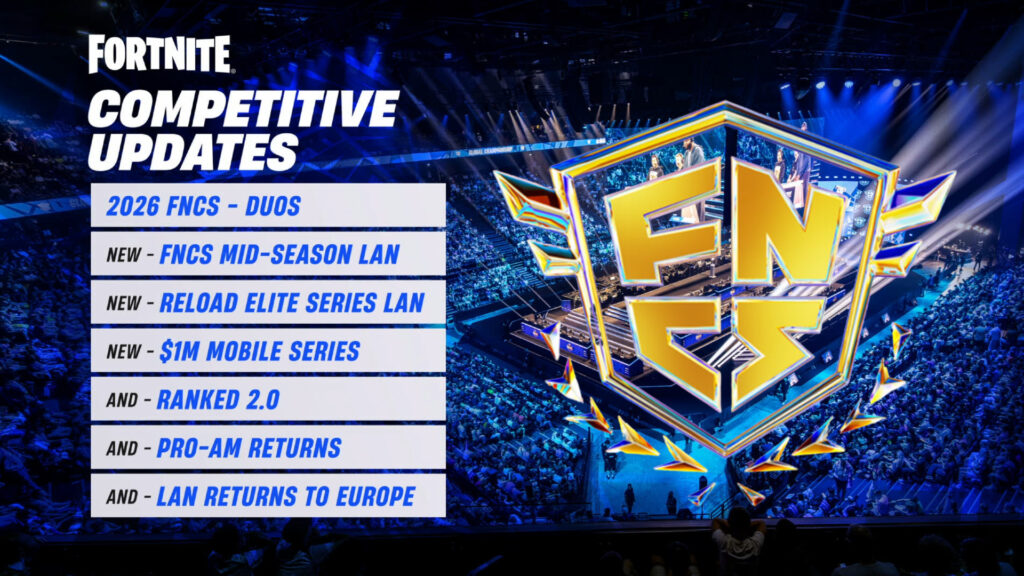
Fortnite’s competitive scene in 2025-2026 features major tournaments and a $10 million+ prize pool across the year. Here’s what’s relevant for ranked players:
Road to Unreal ($1 Million Unreal Cup)
Epic Games launched the Road to Unreal series starting December 5, 2025:
- Daily Ranked Cups (December 5-21) – Compete in duos to earn rank points and cosmetic prizes
- Unreal Cup Finals (December 20, 2025) – Top players compete for $1,000,000+ prize pool
- Qualification requirement: Must reach Unreal rank by December 20 to enter finals
This tournament series directly incentivizes ranked grinding and gives competitive players a reason to push for top ranks beyond bragging rights.
FNCS 2026 Format (Duos Return)
The Fortnite Championship Series 2026 begins January 31, 2026, with major changes:
- FNCS Trial (January 31) – Duos placed into divisions based on performance
- Division 1 requirement – Only Division 1 players can enter FNCS Major tournaments
- Three online Majors – Leading to FNCS Global Championship (November 2026)
- $10 million+ prize pool across the full competitive year
For serious competitive players, this means climbing to Champion or Unreal rank is essentially required to access Division 1 Cups and FNCS qualification opportunities.
Mobile Series & Reload Elite
Epic also announced new competitive formats for 2025-2026:
- $1 Million Mobile Series – Solo touch-only tournaments starting December 2025
- Reload Elite Series – Competitive tournaments for the fast-paced Reload mode
- Blitz Mobile Cup – Ongoing mobile-specific competitions
These alternative competitive scenes provide ranked-style play for different audiences, but the core Battle Royale/Zero Build ranked modes remain the primary competitive pathway.
Strategies for Climbing Ranks Faster
Reaching higher ranks requires more than just mechanical skill. Here are proven strategies for climbing efficiently:
1. Prioritize Consistency Over High-Kill Games
The mistake: Chasing 10+ elimination games but dying mid-game
The fix: Focus on consistent top-10 finishes with 3-5 eliminations
Rank progression rewards consistent performance more than occasional pop-off games. A player who averages 4 kills and top 5 placement will climb faster than someone who gets 12 kills but dies at 15th place half the time.
2. Learn Optimal Rotation Paths
The mistake: Running through open fields late-game and getting third-partied
The fix: Study zone rotations and identify natural cover paths
High-rank players spend hours learning map geography to identify safe rotation routes. Use terrain, buildings, and natural cover to move between zones without exposing yourself unnecessarily. This single skill separates Platinum from Diamond more than aim or building.
3. Master One or Two Playstyles
The mistake: Constantly changing between aggressive W-key and passive placement
The fix: Commit to a consistent strategy that matches your strengths
Some players climb fastest by playing edge zones and avoiding fights until endgame. Others succeed with aggressive midgame to secure mats and better loadouts. Find what works for your skill set and execute it consistently rather than flip-flopping based on mood.
4. Duo/Trio with Consistent Teammates
The mistake: Solo queuing or playing with random fills every match
The fix: Find reliable teammates who communicate and match your skill level
Solo queue ranked is brutal. Random teammates often don’t use mics, make questionable rotations, or abandon you mid-fight. Playing with a consistent duo or trio who understand your playstyle and communicate effectively can double your climb speed.
Need reliable teammates? Finding players who won’t rage-quit or grief is difficult in random Discord servers. GameTree’s Discord bot matches you with Fortnite players based on playstyle compatibility and communication preferences. Type /lfg Fortnite to find teammates who actually coordinate rotations and share loot.
5. Optimize Your Settings & Hardware
The mistake: Playing on default settings with inconsistent FPS
The fix: Reduce graphics settings for maximum frames and minimal input lag
Competitive Fortnite requires:
- 120+ FPS minimum (240+ FPS ideal on PC)
- Low input lag – Reduce visual settings to Epic only for draw distance
- Proper sensitivity – Find a balance that allows tracking and flick shots
- Keybind optimization – Place builds and edits on easily accessible keys
These technical optimizations matter more as you climb. Bronze-Gold can be achieved with average hardware, but Platinum+ requires smooth performance to compete with mechanically gifted players.
Seasonal Rewards & Rank Incentives
Epic Games offers exclusive cosmetics for reaching specific ranks each season:
Cosmetic Rewards by Rank
- Bronze-Silver: Sprays and emoticons
- Gold: Unique loading screen
- Platinum: Animated spray and banner
- Diamond: Exclusive back bling
- Elite: Unique pickaxe variant
- Champion: Exclusive glider
- Unreal: Animated outfit style (most prestigious)
These rewards are seasonal exclusives. Once the season ends, they become unobtainable. This creates urgency for players to climb before the March 4, 2026, deadline for Chapter 7 Season 1 rewards.
Tournament Qualification Access
Beyond cosmetics, high ranks unlock competitive opportunities:
- Champion & Unreal: Automatic access to Division 1 Cups (FNCS pathway)
- Diamond+: Eligible for select Cash Cups and region-specific tournaments
- Platinum+: Can enter some community-run competitive events
For aspiring competitive players, reaching Champion or Unreal is essentially required to access the tournament ecosystem that leads to professional play.
Frequently Asked Questions
Can you derank in Fortnite?
Yes, you can drop ranks in lower tiers (Bronze through Diamond). Losing enough points through poor placements and early eliminations will demote you to lower divisions. However, once you reach Elite, Champion, or Unreal, you cannot be demoted for the rest of the season.
How long does it take to reach Unreal?
Reaching Unreal typically requires 100-300 hours of competitive play across a season, depending on skill level. Professional players can hit Unreal in 30-50 hours, while average players grinding from Bronze might need the full 90-day season. Consistent top-10 placements with 5+ eliminations accelerate progress significantly.
Do ranks reset every season?
Yes. Ranks reset at the start of each new Fortnite season (approximately every 90 days). However, you don’t drop all the way back to Bronze. Your starting rank after the reset depends on your finish in the previous season. For example, ending at Platinum III might place you at Gold II after reset.
Is Zero Build easier to rank up in?
It depends on your background. If you come from other shooters (Apex, Warzone, Valorant) without building mechanics, Zero Build may feel easier because positioning and aim translate directly. However, the average Zero Build rank (Silver II) is lower than Battle Royale (Gold I), suggesting the player base is less experienced overall.
What’s the difference between hidden MMR and visible rank?
Visible rank is what you see on your profile (Bronze, Silver, Gold, etc.). Hidden MMR is Epic’s internal skill rating that determines matchmaking. Your MMR tracks true skill independently from rank, preventing situations where high-skilled players crush lower ranks or vice versa. Matchmaking prioritizes MMR over visible rank for fair games.
How many points do you need to rank up in Fortnite?
Fortnite doesn’t show exact point totals in the current ranked system. Instead, your rank bar fills as a percentage based on performance. Typically, 3-6 wins with average performance (top 10 placement, 3-5 eliminations) will promote you one tier. However, strong performances with high placements and multiple eliminations can accelerate this significantly, sometimes promoting you after just 2-3 games.
The hidden MMR system also affects how many points you gain per match. Playing against higher-skilled opponents yields a higher percentage of points per win, while beating lower-skilled players yields less progress.
How do I qualify for FNCS tournaments?
To enter FNCS 2026 tournaments, you must:
- Participate in the FNCS Trial (January 31, 2026) to get placed into a Division
- Reach Division 1 through Divisional Cups and performance
- Maintain your Division 1 status to access FNCS Major Play-Ins
- Place high enough in Play-Ins to qualify for Heats and Finals
The practical requirement is reaching Champion or Unreal rank in regular ranked mode, as this automatically grants Division 1 access.
What’s Next: Chapter 7 Season 1 & Beyond
Chapter 7 Season 1 runs until March 4, 2026, giving players roughly 2 months remaining to climb ranks and earn seasonal rewards. Epic Games has confirmed additional updates rolling out throughout the season:
- Ranked 2.0 full launch – Complete performance-based system details
- Mid-season balance patches – Weapon adjustments and meta shifts
- Additional Ranked Cups – More opportunities to compete for prizes
- FNCS Trial preparation – Leading into January 31 Division placement
For competitive players, this season represents the transition period before FNCS 2026 fully launches. Grinding to Champion or Unreal now positions you optimally for Division 1 qualification when the new competitive year begins.
Conclusion: Your Ranked Journey Starts Now
Fortnite’s ranking system in 2026 offers the most refined competitive experience yet. With Ranked 2.0 emphasizing overall performance rather than just eliminations, players who master positioning, rotations, and team coordination will climb faster than pure fraggers.
Whether you’re starting your Bronze I placement matches or grinding that final push to Unreal, understanding how the Fortnite ranked point system works helps you set realistic goals and track progress effectively. The competitive scene has never been healthier, with $10 million+ in FNCS prizes and daily ranked events keeping the ladder active year-round.
Key takeaways:
- Eight ranks with 18 total tiers from Bronze to Unreal
- Performance-based progression rewards consistent play over occasional high-kill games
- Elite, Champion, and Unreal ranks cannot be lost once achieved
- Ranked 2.0 updates emphasize holistic performance metrics
- FNCS 2026 requires Champion/Unreal for Division 1 competitive access
Ready to climb the ranked ladder but tired of toxic random teammates? Solo queue is a grind when fills won’t rotate properly or communicate. Download the GameTree app for personality-based teammate matching that pairs you with players who share your playstyle and communication preferences, or use our Discord bot for instant LFG by typing /lfg Fortnite in any server with GameTree installed.
Sources
Community consensus from competitive Fortnite players and content creators
Fortnite Tracker – Rank Distribution Data (October-December 2025)
Epic Games Official Blog – “Join the Road to Unreal in Fortnite Competitive” (November 28, 2025)
Esports.gg – “When is Ranked coming back to Fortnite?” (December 3, 2025)
Fortnite Tracker – “FNCS 2026: Duos Return, $10,000,000+ Prize Pool” (December 2025)
Esports Tales – “Fortnite Rank Distribution in October 2025: Battle Royale and Zero Build” (October 24, 2025)
Sportskeeda – “Epic Games confirms Fortnite Ranked 2.0 mode” (September 8, 2025)
Esports Insider – “What is the highest rank in Fortnite in 2025?” (October 8, 2025)
Official Fortnite Wiki – Ranked Mode Documentation (Updated December 2025)
Frequently Asked Questions
What Is the Fortnite Ranked System?
This is a system that determines which lobby the player will end up in and who they will play with, depending on their skills.
How Do You Play Fortnite Ranked?
To play in the Fortnite ranked mode, you need to select the game mode in which you want to compete, be it Battle Royale or Zero Build, and select Ranked in the Mode Selection option.
Is Ranked Fortnite Harder?
Yes, the ranked mode in Fortnite is more difficult than regular, casual modes since, in ranked mode, players are focused on results and moving up the ranking ladder. Therefore, players will make every effort and tricks to win. Think of the new Fortnite ranked mode as something like an eSports tournament where you play not for fun but for results.
How many Fortnite ranks are there?
There are eight Fortnite ranks, from lowest to highest: Bronze, Silver, Gold, Platinum, Diamond, Elite, Champion, and Unreal.
Yes, you can go down ranks in Fortnite. If you lose enough points through early eliminations or poor performances, you'll be demoted to lower divisions and eventually to previous rank tiers.