





How to Create a Better Experience in Multiplayer Games
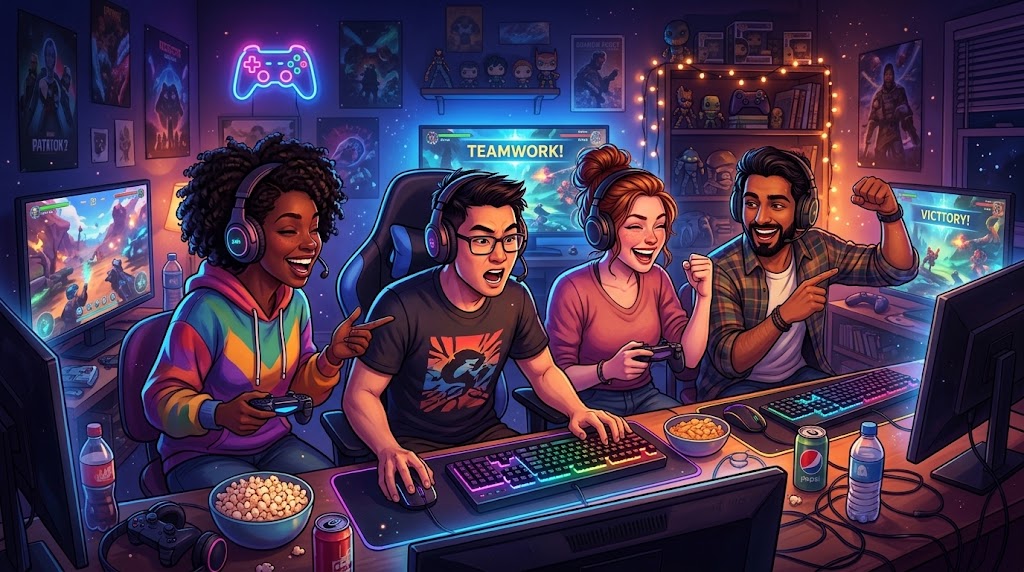
Multiplayer games are not just about finishing missions and beating opponents or racking up points on the leaderboard. They unite people, provide opportunity for teamwork, and provide players with a platform to develop friendships through common experiences. From competitive shooters, cooperative adventures, survival games, to party games, the companions you play with can make a massive difference in how much fun you have.
But not all multiplayer sessions are successful. The absence of communication, bad behavior, unfair competition, and arguments can make for a really trying game. While it can be difficult to find good team members, there are a few useful tips to make it easier to join a friendly gaming community.
The positive side is that it’s not necessary to be the best in the lobby to have fun in a multiplayer game. Clear communication, respecting others, selecting the right communities and an honest, healthy competitive mindset will make for better experiences for you and others.
Find the Right Gaming Community
It’s not always about the game, it’s about the people you play with. Some players like to game and strategize, others like to relax and experiment, make some mistakes and have a good time. There are no right or wrong options, but it can be fun to play with others who have the same expectations.
First, consider what you’re looking for in multiplayer games. Players who enjoy ranked play should find players who place an emphasis on improving and are willing to discuss strategies. For more casual play, there are communities that offer friendly matches or co-op games.
You can find gaming forums, Discord servers, match making websites and community groups that will enable you to get in touch with folks who have similar interests. Take time and watch the interactions and discussions of each group before deciding to join one of them. Pay attention to how the more advanced members welcome the beginning members, how the moderators deal with conflict, and if anyone appears to be at ease in the participation process.
Look Beyond Skill Levels
It would be easy to pick team members only due to their rank, statistics or competitive performance. Skill is only important in some circumstances and not all others when deciding if a person will be fun to play with.
A player with a high skill level who is always telling his team to “come on” and “get moving” can make all games difficult. In the meantime, a more experienced player who can talk and is positive and encouraging to the team may be able to add much more to a successful session.
Find individuals who know what you’re looking for. Players who share the same objectives, value your time and take an active, positive role in learning from your errors are more useful than players who are only interested in winning.
Communicate Clearly and Work as a Team
One of the most crucial aspects of multiplayer gaming is good communication. If no one communicates, no one tells their teammates what they’re going to do, or coordinates what they’re doing, then even a great team can fall apart.
For competitive games, communication aids teammates in knowing what they should do. A brief call out with information about location of opponents can help prevent ambushes and a callout with information about available resources can help plan a team’s next move. When playing cooperative games, you can avoid unnecessary failures by explaining how a puzzle works or warning others of an approaching enemy.
The lesson is to convey information that assists the team and not to let every moment pass by without words of comment. Be clear with instructions, don’t shout over other players and allow your teammates enough time to respond. Use voice chat, ensure the microphone is audible and keep background noise to a minimum.
Give Feedback Without Creating Conflict
In multiplayer games, errors are bound to happen. People may miss a vital shot, go on the wrong turn or misinterpret a strategy. How teammates handle these events can make or break the team’s ability to gain from the error or end up arguing all day long.
Rather than pointing fingers on a bad decision, let them know how it can be done better the next time. For instance, the statement, “Let’s wait for everyone before going into the next room”, gives a very good suggestion. When someone says, “You always do that,” it’s no longer a gameplay issue, it’s a personal attack.
Also, take feedback from others. Sometimes you won’t make the best choice and a teammate’s suggestion could help you make the better choice. A group that views mistakes as learning opportunities will not be at risk of becoming uncooperative following an unfortunate performance.
Make Gaming Communities Welcoming for Everyone
Creating a positive gaming environment isn’t a natural by-product. It is nurtured during regular activities such as appointment making, greeting of new members, and the way to react to inappropriate behavior.
New players may feel intimidated when they join an online community where everyone is well-known to one another. They may not feel comfortable asking questions or joining voice chats or group activities due to concerns about being judged. These players can be made to feel more at ease with the help of small gestures.
Experienced members can provide explanations for the mechanics they don’t understand, help new players to games that are appropriate, and not be degrading towards the mistakes of new players. Community organizers can also be able to organize events specifically for each type of skill, so that those with the skill can participate without being immediately placed in a position where they have to prove themselves to be able to.
Set Boundaries and Address Toxic Behavior
While competitive games are fun, there’s a distinction between teasing and annoying another player and between teasing and harrying another player. People like to make jokes, and jokes that are repeated throughout the friendship can make the players feel unwelcome in the group, whereas repeated insults or unwanted personal comments can also make the players feel unwelcome.
When another player crosses a boundary, it is possible to explain this to them without getting angry. Don’t let an argument take up the entire session- use any possible mute, block, or report features available.
Important also is the moderator in the community. Consistent rules and procedures are enforced and there are reporting systems in place to help members know what is acceptable behavior. Moderators serve as an integral part of the community and contribute to its confidence by responding fairly, not favoring its friends.
Stay Aware of Who You Meet Online
Multiplayer games allow you to make new friends and develop real-world friendships with people from different backgrounds. But the same cautious approach is necessary when players start to communicate off the game as well.
Don’t assume that all you know about a user behind a user name or profile picture is what you see in the profile. What most players are trying to do is have fun playing their favorite games, but some accounts may be falsely identifying themselves or be misusing their intentions.
This does not imply that you should not trust people you come across. Instead, take time to get to know them, watch for repetition of their behavior, and refrain from giving out any personal information they aren’t used to. You can play social games without disclosing your home address, financial information, passwords or other private information.
Use an AI Image Detector to Assess Visual Content
An AI image detector can be helpful for analyzing images to detect visual patterns that could be a sign of AI-generated imagery. It can assist gaming communities with moderation by examining whether a profile photo is suspicious, reviewing potentially misleading images, and making better-informed decisions about the authenticity of photos. An AI image detector can help with more in-depth analysis of suspicious content that goes beyond what can be seen with the human eye.
However, the results from the detection are intended to be a guide only. These tools are capable of predicting whether an image is likely to be AI-generated and their effectiveness can depend on the image in question and how it was originally created. When used with context and good judgment, users can make less hasty judgments about an individual’s intentions based on their analysis of the results.
Learn How to Recognize AI-Generated Pictures
When playing online, profile pictures are one of the initial details that are noticed. The use of a familiar character, a personal photograph or original drawing or illustration can enhance a person’s expression of interests and personality. Images can however be copied, manipulated and even generated using artificial intelligence.
Knowing how to recognize AI generated pictures can help you examine suspicious images more thoughtfully. Some AI-generated pictures contain unusual details, inconsistent lighting, distorted backgrounds, or strange-looking hands and facial features. Other images may appear convincing, especially when they have been edited or generated using advanced tools.
While these clues may be useful, none of them are definitive proof that an image is fake. Real photos might be out of the ordinary due to the lighting, compression, filters, or editing. Likewise, AI-generated images can also be hard to tell apart from real photos.
But most significantly, an AI-made face is not necessarily a red flag for dishonesty. Lots of people use fictional characters, drawings, and art generated by artificial intelligence just because they like the style or don’t want to share their photos. Pay attention to the person’s behaviour, and if they are lying to you in a way that is unsafe or untrustworthy.
Manage Competition Without Losing the Fun
Multiplayer games are fun and can be competitive, which allows players to have clear goals and feel as if they are making progress. To win a tough game is satisfying, especially when they have been a team and have overcome a problem. Issues occur when the results outweigh the experience.
When each defeat is a defeat to oneself, gaming can turn out to be exhausting. Players can start pointing fingers at teammates, start to discuss minor aspects of the game, or play on beyond the point of enjoyment.
Instead, try to concentrate on what you can do about it, so that you can have a healthier attitude. You may focus on your shooting, learn a new character, find out how to communicate better, or get to know the map. Even if your team does not win all games, these goals will have something to aim for.
It also aids in identifying when to take a break. If you are becoming frustrated or impatient with friends, take a break. The next session will be more enjoyable if the first one is done with a clearer mind.
Improve Your Gaming Setup and Habits
The ambiance of your surroundings can affect the fun and comfort of playing multiplayer games. While expensive equipment isn’t essential to enjoying yourself, there are some simple changes you can make. A stable internet connection minimises disruptions and simplifies team coordination. A good headset will make it easier to hear what is important in the game, and an ergonomic chair and screen will make longer sessions easier.
Here are some low-tech fixes you can make:
- Make sure you have a good connection: Avoid doing unnecessary downloads on a poor network during a game.
- Set up your preferences: Fine-tune your graphics, sensitivity and audio levels to meet your preference and hardware capabilities.
- Sit your monitor at a comfortable height and angle, take regular breaks and do not sit in one position for too long.
- Secure your accounts: Assign strong passwords and if you can, turn on two-factor authentication.
The way you play is as important as the equipment you use. Find other things to do, get a proper sleep schedule and don’t let a frustrating match wreck the rest of the day. The idea is to make gaming a part of your life that leaves time for other hobbies and obligations.
Build Better Experiences One Session at a Time
Creating a better multiplayer experience does not require dramatic changes. It begins with choosing compatible teammates, communicating respectfully, welcoming newcomers, and knowing when to set boundaries. Being thoughtful about online identities and protecting your personal information can also help you navigate gaming communities more confidently.
Most importantly, remember that multiplayer games are meant to be enjoyed. Focus on learning, cooperation, and the people you meet along the way. When you contribute to a welcoming environment and surround yourself with players who share your values, every session has a better chance of becoming something worth looking forward to.